Precision Kitchen: How Cooking Calculators and Converters Perfect Every Recipe in 2026
Cups to grams, recipe scaling, cooking time per pound, oven temperature conversion — kitchen math tools that turn recipe guesswork into consistent results.

Precision Kitchen
Cooking is applied chemistry — ingredients interact in specific ratios to produce specific textures, flavors, and structures. A bread recipe is not a loose suggestion; it is a formula where the ratio of flour to water to yeast to salt determines whether the loaf rises properly, develops the right crumb structure, and tastes correct. When that ratio shifts — because a cup measurement was imprecise, because a recipe was scaled without adjusting leavening agents correctly, or because a Celsius oven ran at Fahrenheit temperatures — the result is predictably different from the intended outcome.
The most consistent home cooks are not the most talented — they are the most precise. Professional kitchens do not measure by eye; they measure by weight, every time. They do not guess cook times; they calculate per-pound or per-kilogram guidelines and monitor internal temperature. They do not convert recipes in their head; they use tools that eliminate arithmetic errors in proportioning.
ToolsACE provides a complete kitchen math calculator suite covering recipe scaling, unit conversions, baking precision, and cooking time calculations. This guide covers every tool with practical kitchen applications.
"The difference between a good home cook and a great one is usually not skill — it is precision. Precision starts with measurement."
Recipe Scaling
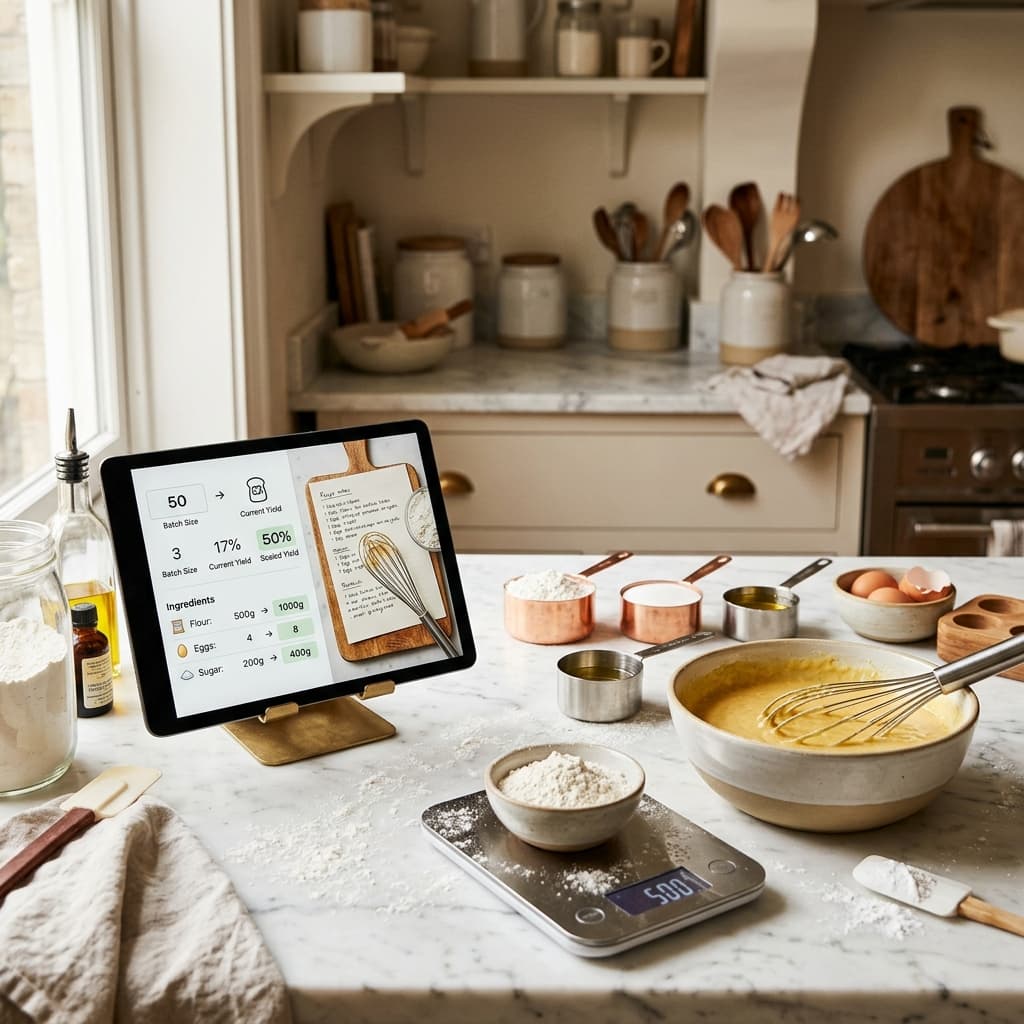
Recipe scaling seems simple — multiply everything by 1.5 for a larger batch, divide by 2 for a smaller one — but several elements of a recipe do not scale linearly, and getting them wrong produces dramatically different results from the original.
What Scales Linearly
Most ingredients — flour, sugar, butter, milk, eggs — scale proportionally. Double the recipe, double every ingredient. The recipe scaling calculator handles this multiplication for any batch multiplier (1.5×, 2×, 0.75×, etc.) and converts resulting quantities into practical measurements.
What Does Not Scale Linearly
Leavening agents (baking powder, baking soda, yeast) should not be scaled at the same ratio as other ingredients — typically use 75–80% of the calculated amount when scaling up. Salt, spices, and vanilla also tend to be reduced by 20–25% when doubling or tripling, as their flavor intensifies disproportionately.
Pan size also affects scaling. A recipe designed for an 8-inch round cake pan has different batter depth and surface area than the same recipe doubled in a 9×13 rectangular pan. Baking time and temperature need adjustment when pan geometry changes — which the cooking time calculator accounts for when you specify pan dimensions.
Unit Conversions
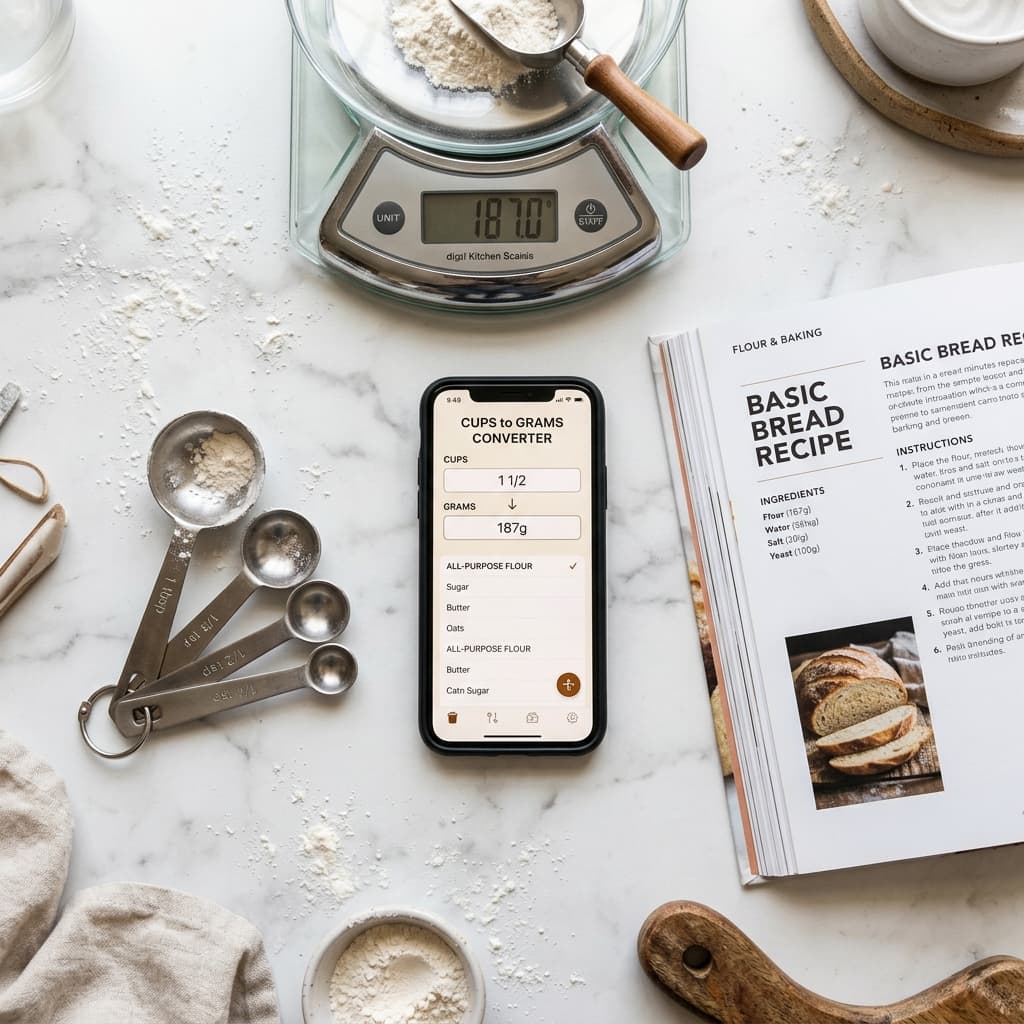
The kitchen is the most unit-conversion-intensive environment most people regularly encounter. US recipes use cups, tablespoons, teaspoons, ounces by volume, and pounds. European and international recipes use grams, milliliters, and liters. Professional recipes use weight exclusively. Converting between these systems accurately requires knowing the density of each ingredient — because cups measure volume, not weight, and different ingredients have wildly different densities.
- Cups to grams: 1 cup of water = 237g, 1 cup of all-purpose flour = approximately 120–125g (varies with scooping technique), 1 cup of granulated sugar = approximately 200g, 1 cup of butter = 227g. The same volume contains entirely different weights depending on the ingredient.
- Tablespoons and teaspoons: 1 tablespoon = 3 teaspoons = approximately 15g of water. For butter, 1 tablespoon = 14g. For baking soda and salt, 1 teaspoon = approximately 6g and 6g respectively (roughly similar density to water).
- Ounces to milliliters (liquid): 1 US fluid ounce = 29.57 mL. A standard "shot" in the US is 1.5 fl oz = 44 mL. A standard wine pour of 5 fl oz = 148 mL.
Baking Temperature Reference:
Moderate oven
350°F / 175°C
Hot oven
425°F / 220°C
Very hot oven
475°F / 245°C
Baking Precision
Baking is the most precision-dependent form of cooking because it involves irreversible chemical reactions. Overproof yeast-leavened dough cannot be corrected by reducing oven time. A cake with too much baking soda develops a soapy bitter flavor that cannot be masked by frosting. Chocolate chip cookies with too little flour spread into flat discs; too much flour produces dry pucks. The window of acceptable ingredient variation in baking is narrow.
The single most impactful habit change a home baker can make is switching from volume to weight measurement. Digital kitchen scales accurate to 1 gram eliminate the primary source of variation in home baking — inconsistent cup packing. Professional bakers measure everything by weight. "2 cups of flour" measured by three different people in three different kitchens can vary by 20–40% depending on how the flour is scooped, whether it is sifted, and the humidity of the environment. "240 grams of flour" is unambiguous and reproducible.
Cooking Time Tools
Protein cooking times scale with weight, not volume, and the relationship is not strictly linear — a larger roast has more thermal mass and takes proportionally longer per pound than a smaller one, but also retains heat longer. The cooking time calculator uses weight, cooking method (roasting, braising, slow-cooking), and target internal temperature to compute estimated cooking time for poultry, beef, pork, and lamb.
Internal temperature is the definitive doneness indicator — not color, not texture, not elapsed time alone. USDA recommended safe internal temperatures: ground beef 160°F (71°C), whole poultry 165°F (74°C), pork 145°F (63°C), beef steaks and roasts 145°F for medium. Using a probe thermometer with these target temperatures eliminates both food safety risk (undercooking) and quality risk (overcooking) simultaneously.
Kitchen Math System
Step 1: Switch Baking to Weight Measurement
Invest in a digital kitchen scale. For all baking recipes, use grams rather than cups. Use the cups-to-grams converter to find the weight equivalents for any recipe initially written in volume. Once you have the gram measurements for your regularly-made recipes, the scale becomes faster than measuring cups.
Step 2: Pre-Calculate Recipe Scaling Before Cooking
When scaling a recipe, use the recipe scaling calculator to compute all ingredient amounts before beginning. Write the scaled amounts on the recipe before you start. Never scale mentally while cooking — distraction and rushing produce calculation errors at exactly the moment when precision matters most.
Step 3: Calculate Cook Time from Weight
For any roast, whole bird, or large cut, use the cooking time calculator before it goes in the oven. Build backward from when you want to serve to compute when to start cooking, including 20–30 minutes of rest time for large roasts after they leave the oven.
Step 4: Verify Oven Temperature with a Thermometer
Oven thermostats are notoriously inaccurate — calibration errors of 25–50°F are common. An oven running 50°F low burns cookies on the outside before the center sets, and causes cakes to dome and crack. Buy a $10 oven thermometer and know your actual oven temperature.
FAQs
Why do baking recipes sometimes fail even when I follow them exactly?
Can I convert any recipe from cups to grams?
How do I adjust cooking time when I change the pan size?
Author Spotlight
The ToolsACE Team
ToolsACE is an independent platform founded in 2023 by a team of software developers and educators committed to making precision tools accessible to everyone, for free.