Pet Health by the Numbers: The Complete Pet Calculator Toolkit for 2026
Dog water intake, cat litter consumption, chicken feed planning, aquarium volumes — every pet owner needs accurate numbers for their animals' health.


Pet Health by the Numbers
Caring for animals requires the same quantitative rigor that governs any other living system. An animal that is chronically underfed, overwatered, underfed during lactation, or kept in an improperly sized environment does not necessarily show dramatic symptoms immediately — the effects accumulate over weeks and months into health problems that manifest as veterinary bills and diminished quality of life for the animal.
The challenge is that pet care quantities vary significantly by species, breed, age, reproductive status, ambient temperature, and activity level. The water intake appropriate for a sedentary 20-pound dog in winter is not appropriate for an 80-pound working dog in summer. The feed quantity for a layer hen at peak production is not appropriate for a bantam in molt. These are not arbitrary recommendations — they derive from measured physiological requirements that have been quantified through animal nutrition research.
ToolsACE provides a complete set of pet and animal care calculators that make these research-backed recommendations accessible with simple inputs. This guide covers every tool with practical guidance for dog owners, cat keepers, chicken farmers, and aquarium hobbyists.
"Your pet cannot tell you it is dehydrated, underfed, or in an overcrowded environment. Calculating their needs accurately is how responsible animal care begins."
Dog Health Tools
Dogs are among the most variable domesticated animals in existence — size ranges from 5-pound toy breeds to 180-pound giant breeds, and their physiology, metabolism, and requirements differ accordingly. The water, food, and environmental space requirements for a Chihuahua bear almost no resemblance to those of a Great Dane, even though both are dogs.
Dog Water Intake Calculator
The dog water intake calculator computes daily hydration needs from body weight, activity level, ambient temperature, and diet type. A 60-pound active dog in summer needs approximately 60–80 oz of water daily — three to four times what the same dog needs at rest in cool conditions.
Dog Age Calculator
The long-held "multiply by 7" rule is a myth. Small breeds mature faster in early years and age more slowly thereafter; large breeds age faster throughout their lives. The dog age calculator uses size-specific curves to convert dog years to human-equivalent age for healthcare and life stage planning.
Monitoring water consumption can also serve as an early health indicator. Sudden increases in water intake (polydipsia) can signal diabetes mellitus, kidney disease, Cushing's syndrome, or other conditions that present with increased thirst as an early symptom. Having a calculated baseline makes it possible to notice meaningful deviations — dogs that start drinking 50% more than their calculated baseline warrant veterinary attention.
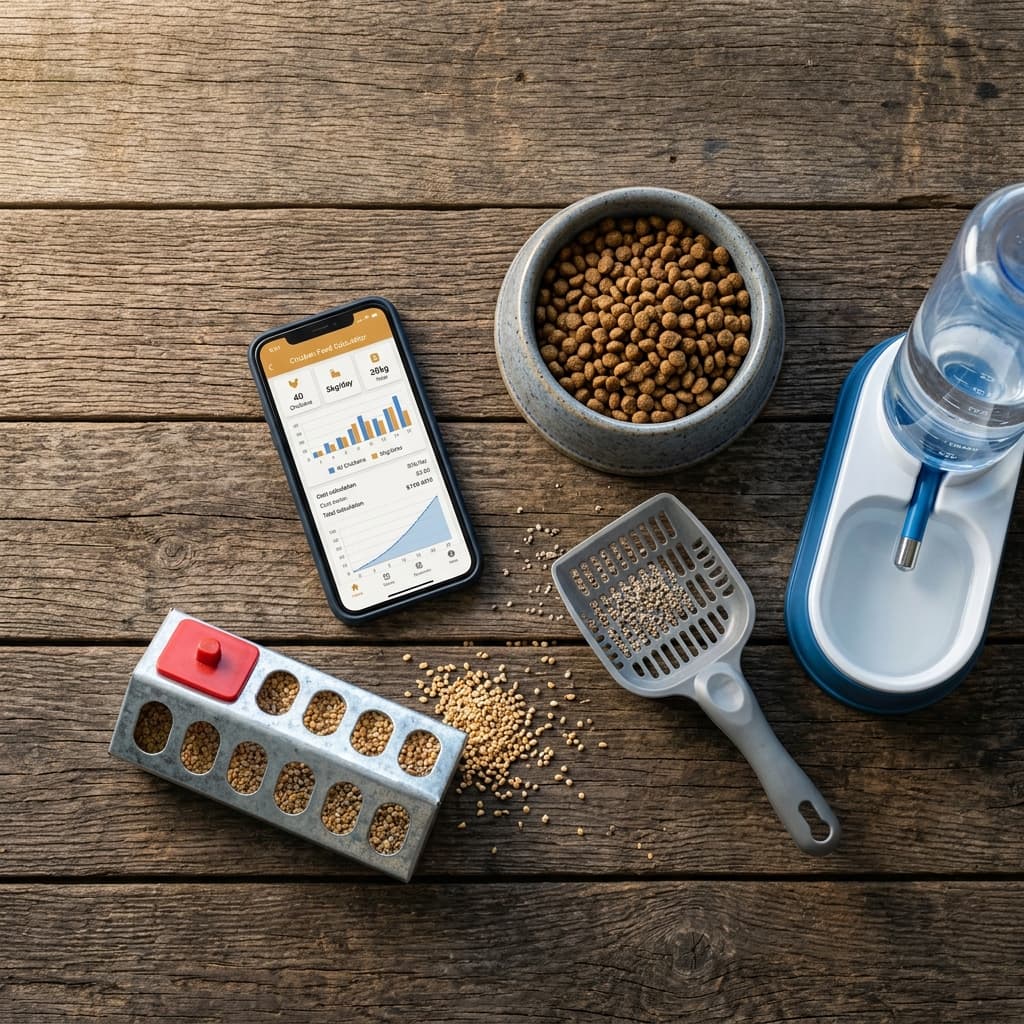
Cat Care Calculators
Cats are obligate carnivores with specific nutritional requirements and territorial behaviors that make their environment management as important as their nutrition. Litter box management is one of the most overlooked aspects of cat husbandry — inadequate litter availability is a leading cause of house soiling, stress-related health problems, and inter-cat aggression in multi-cat households.
The cat litter calculator estimates weekly and monthly litter consumption based on the number of cats, litter type (clumping vs. non-clumping, natural vs. clay), and box change frequency. The standard recommendation is one litter box per cat plus one additional — but even with adequate box count, insufficient litter depth or infrequent cleaning creates aversion. The calculator factors in both usage rate and change schedule to produce a monthly purchase estimate for budgeting and supply planning.
Pet Care Numbers:
Litter boxes per cat
N+1 rule
Chicken feed per hen/day
~0.25 lbs
Dog water (rule of thumb)
1 oz/lb
Poultry & Birds
Backyard poultry keeping has expanded dramatically, but many new chicken keepers significantly underestimate or overestimate feed requirements — leading to wasted feed, inadequate nutrition, or unexpected feed costs that undermine the economics of home egg production.
The chicken feed calculator estimates daily and weekly feed consumption for any size flock based on breed category, flock size, age, production status, and season. Layer hens in peak production (pullets in their first laying year) consume approximately 0.25 pounds of layer pellets per bird per day. Bantam breeds eat approximately 60–70% of this amount. Broilers in finishing phase eat significantly more. Hens in molt or winter low-production periods eat less. All of these variations are accounted for in the calculator's breed and status inputs.
Feed consumption calculations are also essential for ordering in the right quantities. Buying too little means running out mid-week; buying too much means spoilage and waste. The calculator output can be converted directly to 50-pound bag quantities, making feed purchasing a simple calculation rather than a guessing exercise.
Aquatic Pets
Aquarium keeping is one of the most mathematically intensive hobbies — and the one where calculation errors have the most immediate consequences for animal welfare. Fish and invertebrates exist in a closed chemical system where every parameter affects every other parameter: volume affects bioload capacity, bioload affects ammonia accumulation, ammonia affects pH, pH affects toxicity of ammonia, and all of these together affect whether fish survive treatment for disease.
The aquarium volume calculator provides the accurate tank volume number that underpins every other calculation. For fish owners, this number determines the stocking limit (gallons per inch of fish, adjusted for bioload), the weekly water change volume (typically 20–30% per week for freshwater community tanks), the correct dose for dechlorinators and medications, and the amount of salt mix for marine aquariums.
- Chemical dosing: All aquarium medications, water conditioners, and buffering agents specify dosage in ml or drops per gallon. Using nominal tank size instead of actual volume introduces systematic dosing errors.
- Salt mix for reef tanks: Marine salt mix is measured in specific gravity or salinity percentage per gallon. Accurate volume is critical for maintaining stable reef chemistry in systems where invertebrates evolved in one of the most chemically stable environments on Earth — the open ocean.
- Pond stocking: Garden ponds follow the same volume-based stocking rules as indoor tanks. The calculator handles pond shapes as well as rectangular tank shapes.
Pet Health Routine
Step 1: Calculate Water and Feed Baselines
For every animal in your care, calculate their baseline daily water and feed requirements using the appropriate calculator. Post these numbers in your feeding area as a reference. Review and recalculate seasonally or when an animal's age, weight, or activity level changes significantly.
Step 2: Verify Aquarium Volume Before Any Chemical Addition
Before adding any medication, water conditioner, salt, or treatment to an aquarium, confirm the exact gallonage using the aquarium volume calculator with actual dimensions and fill level. The 30 seconds this takes prevents potentially lethal dosing errors.
Step 3: Set Up a Litter Purchasing Schedule
Use the cat litter calculator to determine monthly consumption. Set a recurring purchase or subscription order matched to this quantity. Never running out of litter prevents the stress and behavioral problems that arise when cats are forced to use inadequate facilities.
Step 4: Track Consumption Deviations
Monitor whether your animals are consuming the calculated amounts. Significant deviations — a dog drinking 50% more than calculated, a chicken eating notably less — are early indicators of health problems that warrant veterinary attention before symptoms become serious.
FAQs
How much water does a dog need per day?
How many litter boxes do I need for multiple cats?
Do chickens eat more in winter?
Author Spotlight
The ToolsACE Team
ToolsACE is an independent platform founded in 2023 by a team of software developers and educators committed to making precision tools accessible to everyone, for free.