Physics Made Practical: How Physics Calculators Bridge Theory and Real Life in 2026
Force, velocity, energy, Ohm's law, projectile motion — physics calculators that make the equations you learned in school finally click with real applications.

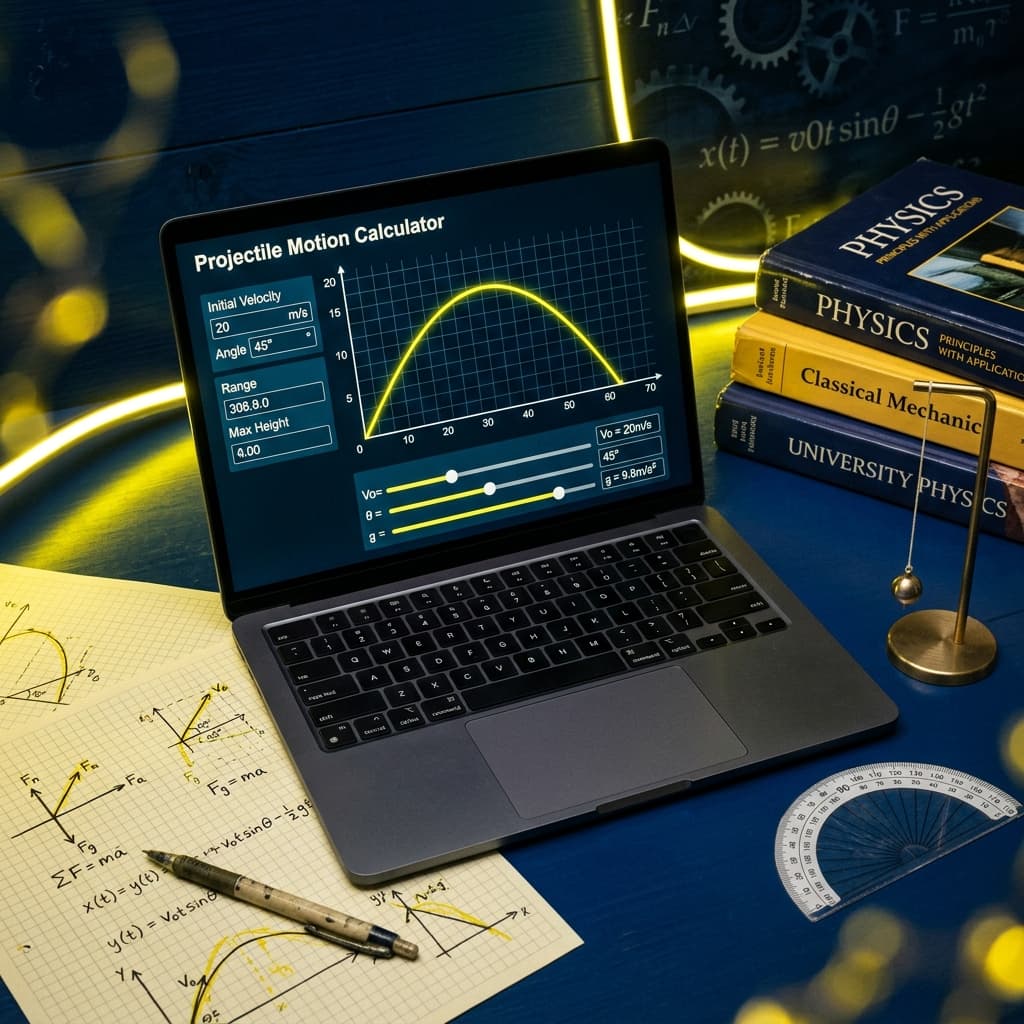
Physics Made Practical
Physics describes the fundamental rules that govern every physical phenomenon — from the motion of a thrown ball to the flow of electricity through a circuit to the bending of light through a lens. It is both the most abstract and the most practically applied of the sciences, underpinning every engineering discipline, medical imaging system, power grid, and electronic device in existence.
Students who struggle with physics often struggle not with conceptual understanding but with algebraic manipulation of the governing equations. Rearranging F = ma to solve for acceleration instead of force requires algebraic comfort that many students lack, causing them to lose marks not on physics understanding but on algebra. Physics calculators eliminate this barrier by accepting any known variables and solving for any unknown — allowing students to focus on understanding what the equation means and when to apply it rather than how to manipulate it algebraically.
ToolsACE provides a comprehensive physics calculator suite covering mechanics, thermodynamics, electricity, and wave physics. This guide covers each tool with the real-world applications that make abstract equations tangible.
"Physics equations are not formulas to memorize — they are relationships to understand. Calculators handle the algebra so you can focus on the relationship."
Classical Mechanics
Classical mechanics describes the motion of objects under the influence of forces. It is the foundation of all other physics branches and the content of most introductory physics courses. The core equations — Newton's laws, kinematics, work-energy theorem, conservation of momentum — appear in virtually every physics application from ballistics to automotive engineering to sports science.
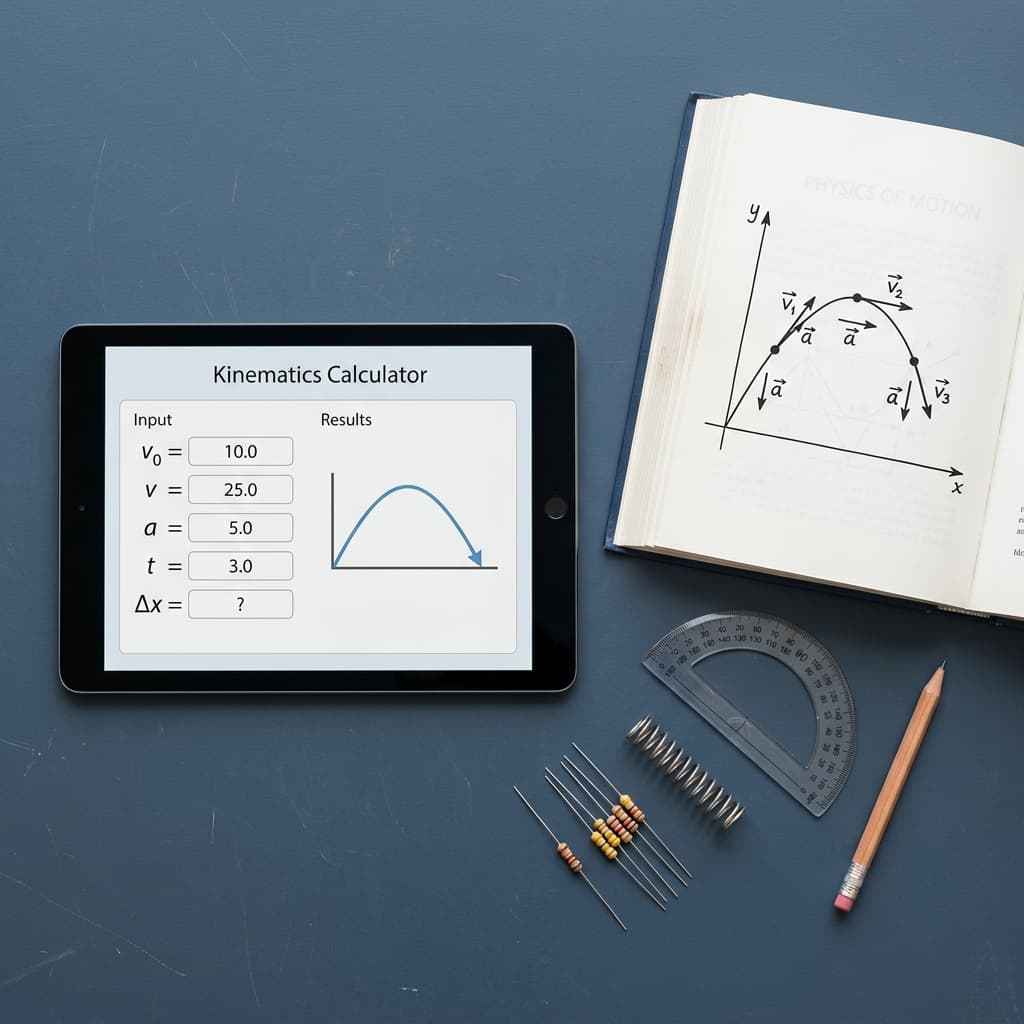
Kinematics Calculator
Solves for any of the five kinematic variables (initial velocity, final velocity, acceleration, displacement, time) given the other three. Handles constant acceleration problems in one dimension — the framework for free-fall, braking distance, and projectile horizontal components.
Projectile Motion Calculator
Computes the trajectory of any projectile launched at any angle with any initial velocity: maximum height, range, time of flight, and velocity components at any point. Used in ballistics, sports physics, and civil engineering (water arcs, thrown objects).
Newton's second law (F = ma) is perhaps the most frequently used equation in physics problem sets. The force calculator accepts any two of the three variables and solves for the third — making it the starting point for every dynamics problem. It also handles weight (W = mg) as a special case, converting between mass in kilograms and gravitational force in Newtons for any gravitational acceleration value (Earth: 9.81 m/s², Moon: 1.62 m/s², Mars: 3.72 m/s²).
Energy & Power
Energy and power calculations span a uniquely wide range of scales — from the kinetic energy of a bullet to the thermal energy released in combustion to the power demand of an industrial motor. Despite the scale differences, the underlying equations are the same, and the calculators handle all of them with identical ease.
- Kinetic energy: KE = ½mv². The kinetic energy calculator computes the energy of any moving object from its mass and velocity. A 1,500 kg car at 60 mph carries approximately 270,000 joules of kinetic energy — equivalent to about 65 grams of TNT. This number makes crash safety engineering tangibly real.
- Potential energy: PE = mgh. The potential energy calculator computes gravitational potential energy from mass, gravitational acceleration, and height. Conservation of energy — KE + PE = constant for a frictionless system — is validated when you calculate both at different points and confirm they sum to the same total.
- Power: P = W/t = Fv. Power is the rate of energy transfer. A 100-watt light bulb consumes 100 joules per second. An electric motor rated at 5 horsepower outputs approximately 3,730 watts. The power calculator converts between Watts, horsepower, BTU/hour, and other power units commonly encountered in mechanical and electrical engineering contexts.
Physics Scales in Context:
Speed of sound
343 m/s
Earth gravity
9.81 m/s²
1 horsepower
746 W
Electricity & Circuits
Electrical physics is the domain of engineers, electricians, and anyone who works with circuits, power systems, or electronic devices. The foundational equations — Ohm's Law, power equations, Kirchhoff's laws — are deceptively simple but applied to extremely diverse real-world problems.
Ohm's Law (V = IR) relates voltage, current, and resistance in any resistive element. Given any two of the three, the Ohm's Law calculator solves for the third. This applies directly to practical problems: if a device draws 2 amps at 120V, its resistance is 60 ohms and it consumes 240 watts. Electrical circuit design, motor sizing, wire gauge selection, and fuse specification all reduce to these basic relationships. The power equation variations (P = IV = I²R = V²/R) are all solved from the same tool.
Waves & Optics
Wave physics describes periodic phenomena — sound, light, water waves, electromagnetic radiation — using the fundamental relationship between frequency (f), wavelength (λ), and wave speed (v): v = fλ. This simple equation describes everything from radio signal transmission to the color of visible light to the pitch of a musical note.
The wave calculator solves for any of the three wave variables given the other two. Radio stations broadcast at specific frequencies in the MHz range; the corresponding wavelengths are in the meter range. Visible light has wavelengths between 380 nm (violet) and 700 nm (red), with corresponding frequencies in the 430–790 THz range. Sound at 440 Hz (concert A) has a wavelength of approximately 78 cm in air at room temperature. All of these calculations follow the same equation.
The Doppler effect calculator extends wave physics to scenarios where source and observer are in relative motion — explaining why a siren sounds higher-pitched as an ambulance approaches and lower-pitched as it recedes. This phenomenon applies equally to light (redshift/blueshift in astronomy) and to speed measurement (radar guns). The calculator computes the observed frequency given source frequency, source velocity, and observer velocity.
Physics Study System
Step 1: Identify Variables Before Calculating
In every physics problem, list what you know and what you are solving for before reaching for any tool. The problem structure tells you which equation to use. A common mistake is reaching for a formula before understanding what the problem is asking.
Step 2: Use Calculators to Verify Dimensional Analysis
After computing a result, check that the units are correct. If you compute "velocity" in units of kg·m/s² instead of m/s, you have used the wrong equation. Units serve as a built-in error-checking mechanism — verify them on every calculation.
Step 3: Connect Equations to Real Situations
For every new equation you encounter, calculate a real-world example: the kinetic energy of your car at highway speed, the power consumption of your air conditioner, the wavelength of the WiFi signal in your home. Concrete examples build lasting intuition faster than abstract exercises.
Step 4: Use Energy Conservation as a Cross-Check
In any mechanics problem involving initial and final states, calculate the total mechanical energy (KE + PE) at both points. In an ideal system without friction, they should be equal. Discrepancies reveal energy lost to friction or errors in your force/velocity calculations.
FAQs
What is the difference between mass and weight in physics?
Why does Ohm's Law only apply to resistors?
What is the relationship between frequency and energy in physics?
Author Spotlight
The ToolsACE Team
ToolsACE is an independent platform founded in 2023 by a team of software developers and educators committed to making precision tools accessible to everyone, for free.