The Academic Arsenal: Every Calculator Students Need to Excel in 2026
GPA tracking, grade calculation, study time planning, chemistry labs — the complete student calculator toolkit that replaces guesswork with academic confidence.


The Academic Arsenal
Academic success in 2026 is not just about studying harder — it is about studying smarter with the right tools. The difference between a student who constantly feels behind and one who stays ahead is often not intelligence or effort, but systematic use of quantitative tools that eliminate uncertainty about where they stand and what they need to do.
Consider the most common forms of academic anxiety: "Will my GPA be high enough for graduate school?" "Can I still get an A in this course if I score 78% on the next exam?" "How many hours do I need to study to cover this material before the test?" Each of these questions has a calculable answer. Running the numbers transforms a vague worry into a specific, actionable target — which is far easier to work with psychologically and practically.
ToolsACE provides a complete set of academic calculators spanning GPA tracking, grade projection, science lab calculations, math tools, and student financial planning. This guide covers every tool with specific use cases for high school, undergraduate, and graduate students.
"Academic anxiety is usually a data problem. When you know your exact GPA, what score you need, and how much study time the material requires, the anxiety converts into a plan."
GPA & Grades
Grade Point Average is the most universally used academic performance metric — and one of the most commonly miscalculated numbers students carry in their heads. Most students know their approximate GPA but not their precise GPA to two decimal places, which matters enormously for scholarship eligibility (3.50 vs. 3.49 can make a difference), graduate school applications (many programs screen at 3.0 or 3.5 minimum), and honor society membership cutoffs.
GPA Calculator
Enter each course, its credit hours, and your letter grade. The GPA calculator weights each grade by credit hours and computes your exact semester and cumulative GPA. Supports both 4.0 and weighted grade scales used by different institutions.
Grade Calculator
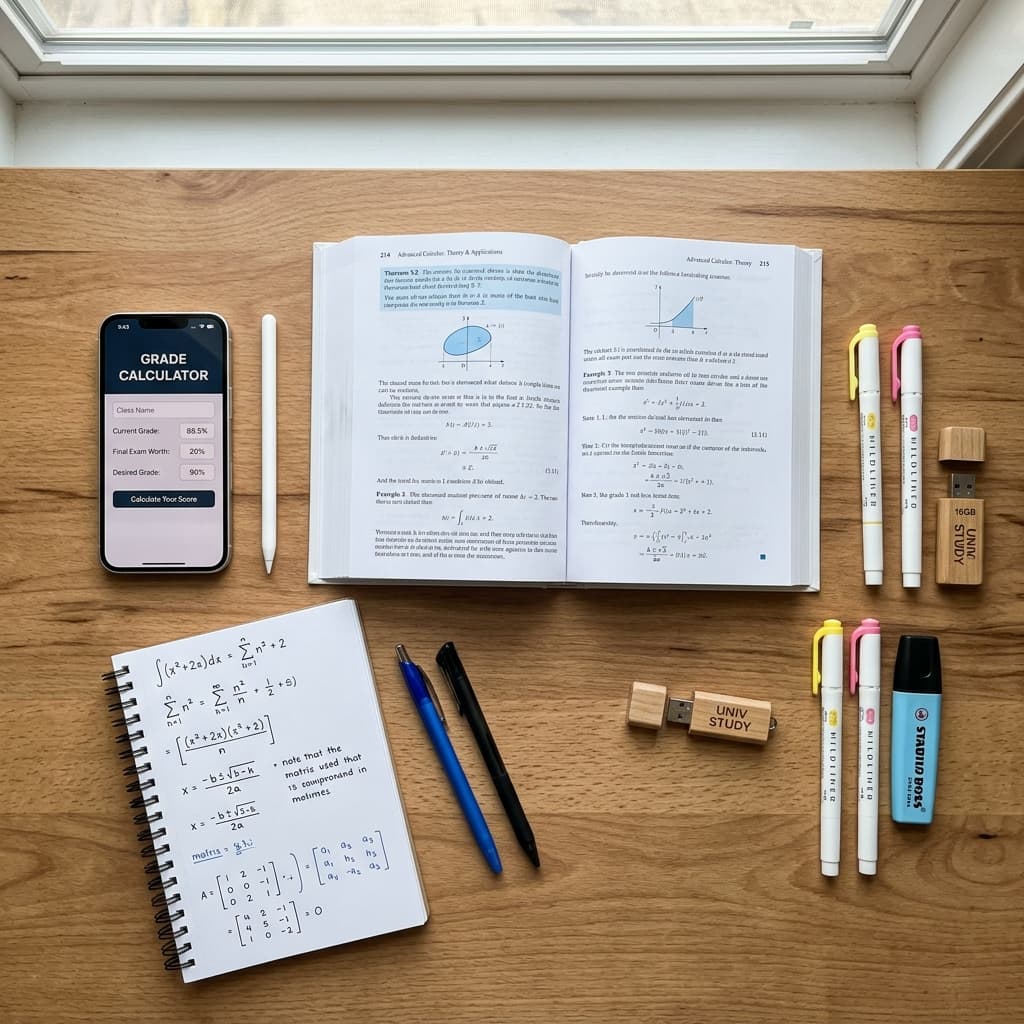
Enter your current scores on all completed assignments weighted by their contribution to the final grade. The grade calculator shows your current standing and computes what score you need on remaining assessments to achieve any target final grade. Eliminates the "I wonder if I can still get an A" uncertainty completely.
The final exam grade calculator is particularly valuable at the end of a semester. Enter your current weighted percentage and the final exam's weight in the overall grade, and it tells you the minimum exam score needed to achieve your target. Knowing you need a 71% on the final for a B allows focused, calibrated preparation rather than panic-driven all-night studying for an A you mathematically cannot reach.
Science Lab Tools
Science courses at every level involve quantitative calculations that are conceptually straightforward but arithmetically tedious when done by hand. Molar mass calculations in chemistry, force and velocity problems in physics, gene probability in biology — these calculations are the scaffolding on which conceptual understanding is built, and arithmetic errors in them obscure whether the student understands the concept or simply made a multiplication mistake.
- Chemistry: Molar mass calculator, molarity and dilution calculator, stoichiometry calculator, percent composition, limiting reagent — the full suite of general chemistry quantitative tools. For advanced students, equilibrium constant calculators and kinetics tools (Arrhenius equation, rate laws) extend into physical chemistry territory.
- Physics: Kinematics calculators (velocity, acceleration, displacement), Newton's second law, work and energy, Ohm's law, wave frequency and wavelength — covers the core quantitative calculations in introductory and intermediate physics coursework.
- Biology: Genetics probability (Punnett square outcomes), Hardy-Weinberg equilibrium, germination rate testing, population growth models — the quantitative side of biology that is often underemphasized in courses but appears heavily on standardized exams.
Academic Math Reality:
GPA points separating B+ from A-
0.33 3.3 vs 3.67 on 4.0 scale
Grade needed to raise 3.0 to 3.5
Varies By credit hours completed
Math & Problem Solving
Mathematics courses form the quantitative backbone of virtually every academic discipline. Whether you are in an algebra-based physics course, a statistics-heavy social science program, or a calculus sequence for engineering, math tools eliminate the arithmetic friction that gets between you and conceptual understanding.
The most valuable math tools for students are the ones that show their work — step-by-step solutions that allow you to check where your process diverged from the correct approach. A calculator that gives you only the answer verifies the answer but teaches nothing. Step-by-step outputs allow you to compare your work line by line and identify exactly where the error occurred, which is the fastest path to skill improvement.
Key math tools for students: quadratic equation solver with full discriminant analysis, systems of equations solver (2×2 and 3×3), polynomial operations, matrix calculator for linear algebra, fraction simplification with GCF, and full statistics suite covering the descriptive and inferential statistics tools used in research methods courses across disciplines.
Student Finance
Student loans are the most significant financial decision most people make before they have any financial education or experience. The math of student loans is opaque by design: total loan amounts are spread across multiple disbursements, interest may capitalize (be added to principal) during deferment, and the difference between income-driven repayment plans and standard plans spans tens of thousands of dollars in total interest paid over a repayment lifetime.
Student Loan Calculator
Computes monthly payments, total interest, and payoff timelines across standard 10-year, graduated, and extended repayment plans. Shows the total cost difference between plans over the full repayment period — often $20,000–$40,000 in additional interest for extended repayment vs. standard.
College ROI Calculator
Compares the total cost of a degree program (tuition, living expenses, opportunity cost of forgone earnings) against projected lifetime earnings premium for the field. Quantifies the break-even point and long-term return — essential for making major program and institution decisions.
Study Success Plan
Step 1: Calculate Your Exact GPA Every Semester
Do not wait for official transcripts. After receiving all grades each semester, recalculate your cumulative GPA precisely. Know your number to two decimal places. This awareness drives strategic course selection — which courses to retake, which to take pass/fail, which to take during summer.
Step 2: Model Your Grades Before Each Exam
One week before any major exam, use the grade calculator to determine your current standing and compute the minimum score needed for each target grade. Calibrate your preparation effort to the math — you may need a 90% for an A or only a 65% to secure the B you need.
Step 3: Use Science Calculators to Check Lab Work
In any quantitative science course, verify all lab calculations with the appropriate calculator before submitting. A single arithmetic error in a stoichiometry problem or a misplaced decimal in a molarity calculation can cascade through the entire lab report.
Step 4: Run the Loan Math Before Borrowing
Before accepting any student loan disbursement, use the student loan calculator to project the full repayment cost under standard terms. Borrow only what the post-graduation income of your field can service at a 10–15% monthly income payment — the standard financial health benchmark for student debt.
FAQs
How is GPA calculated on a 4.0 scale?
Is it possible to raise a 2.5 GPA to a 3.0?
What score do I need on my final exam to get an A?
Author Spotlight
The ToolsACE Team
ToolsACE is an independent platform founded in 2023 by a team of software developers and educators committed to making precision tools accessible to everyone, for free.