Convert Everything: How Unit Conversion Tools Eliminate Costly Mistakes in 2026
Metric to imperial, Celsius to Fahrenheit, pounds to kilograms — unit conversion errors cost time, money, and sometimes lives. The complete conversion toolkit.


Why Conversions Matter
In September 1999, NASA's Mars Climate Orbiter was lost to space because one engineering team used metric units and another used imperial units for the same navigation data. The $327 million spacecraft burned up in the Martian atmosphere. The cause: a unit conversion error that was never caught. This is not an isolated incident in aerospace — unit errors kill projects, ruin recipes, delay construction, and cause medication dosing mistakes in clinical settings every day at every scale.
Most unit conversion mistakes happen not from ignorance but from cognitive shortcuts. Humans are pattern-matching creatures who resist stopping to do arithmetic when they think they already know the answer. A builder who works mostly in feet and inches makes a mental shortcut when someone provides measurements in meters. A pharmacist who works in milligrams makes a quick mental estimate when a dose is given in micrograms. The shortcut introduces error; the error accumulates.
The solution is a frictionless conversion tool that eliminates the temptation to estimate. ToolsACE provides a full suite of unit conversion calculators covering every measurement category you encounter in daily life, school, and professional work. This guide covers the most commonly needed conversions and when precision versus approximation is appropriate.
"Unit conversion is not a minor administrative task. It is the interface between measurement systems, and errors at that interface propagate through every downstream calculation."
Length & Distance
Length conversions are the most frequently needed unit conversions in everyday life — and the category with the largest gap between the two dominant systems. The United States is one of only three countries that has not fully adopted the metric system, meaning Americans routinely encounter metric measurements from manufacturers, scientists, and international sources, while the rest of the world navigates imperial units primarily through American media and product labels.
Common Length Conversions
1 inch = 2.54 cm exactly (by definition). 1 foot = 0.3048 m. 1 mile = 1.60934 km. 1 yard = 0.9144 m. These exact conversion factors make length the most precisely defined category — no approximation is ever necessary with the right tool.
When Precision Is Critical
In manufacturing and engineering, tolerance specifications in inches vs. millimeters require exact conversion. A 0.001-inch tolerance is 0.0254 mm — a precision that matters enormously in CNC machining, aerospace parts, and medical device manufacturing.
For longer distances, the kilometer-to-mile conversion (1 km = 0.621371 miles) appears constantly in travel, navigation, and international running events. Marathon distances (42.195 km = 26.219 miles) are a good memorization anchor. GPS coordinates use decimal degrees for latitude and longitude — an entirely different coordinate system that requires specialized tools beyond simple unit conversion.
Weight & Mass
The everyday distinction between weight and mass is often ignored in non-physics contexts, but the measurement systems for each are equally entangled between metric and imperial. Kilograms, grams, milligrams, and micrograms form the metric hierarchy. Pounds, ounces, and tons form the US customary hierarchy — with the additional complication that "ton" means three different things: short ton (2,000 lbs, US), long ton (2,240 lbs, UK), and metric tonne (1,000 kg, international).
- Kilograms to pounds: 1 kg = 2.20462 lbs. A person who weighs 70 kg weighs approximately 154 lbs. Used constantly in fitness, medical records, and international shipping.
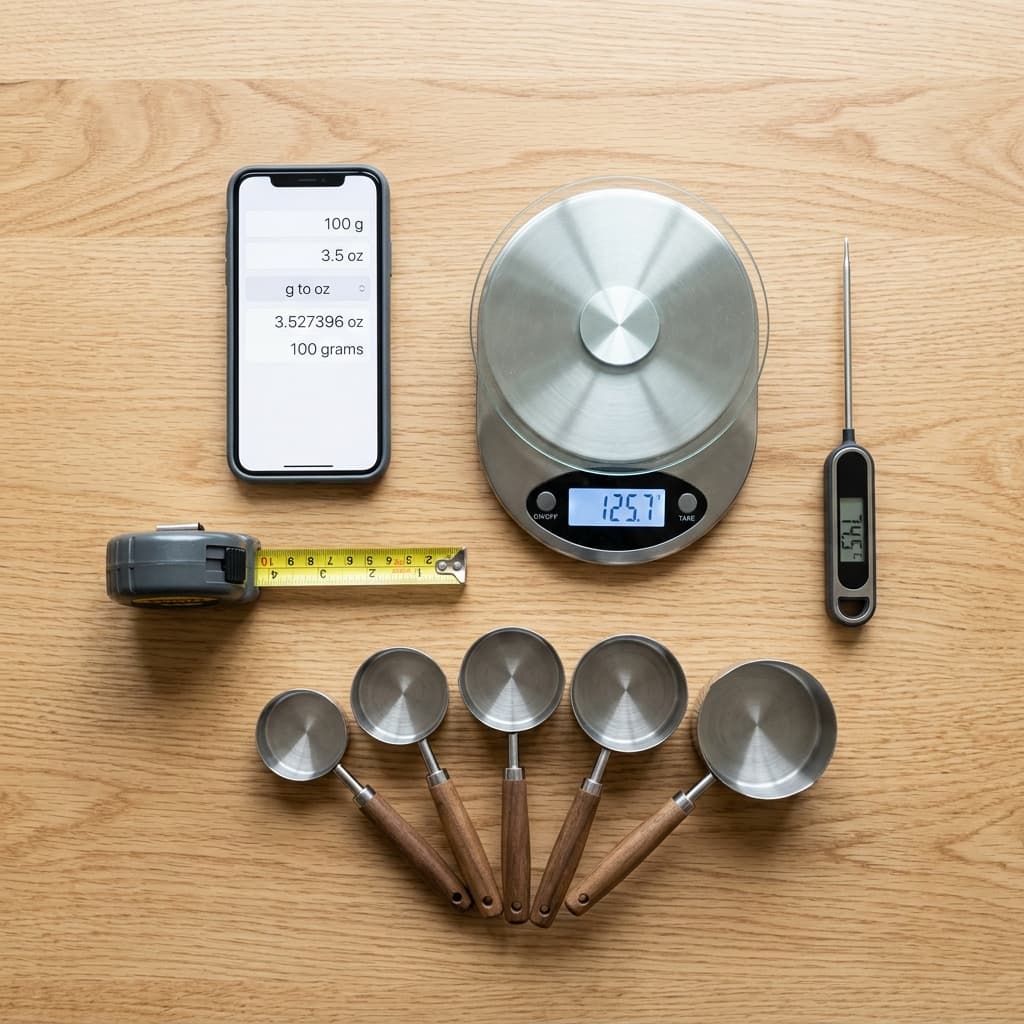
- Grams to ounces: 1 oz = 28.3495 g. A standard serving size of 28g protein powder is approximately one ounce. Cooking recipes switching between systems require this conversion most often.
- Milligrams to micrograms: 1 mg = 1,000 mcg. This conversion is critical in pharmaceutical dosing, where the difference between 10 mg and 10 mcg of a potent drug is a factor of 1,000 — a potentially life-threatening discrepancy.
Temperature
Temperature conversion is deceptively simple in formula but consistently produces errors because the two most common scales — Celsius and Fahrenheit — have different zero points and different scale factors. The formula °F = (°C × 9/5) + 32 is easy to state but easy to misapply when doing mental arithmetic, especially for negative temperatures below freezing.
Temperature Reference Points:
Water freezes
0°C / 32°F
Body temperature
37°C / 98.6°F
Water boils
100°C / 212°F
The Kelvin scale is used in scientific contexts — particularly chemistry, physics, and engineering — where absolute temperature (referenced to absolute zero, -273.15°C) is required. Gas law calculations, blackbody radiation, and thermodynamic efficiency formulas all require Kelvin. The conversion is simple: K = °C + 273.15. Confusing Celsius and Kelvin in a gas law calculation will produce results that are off by orders of magnitude.
Volume & Capacity
Volume conversions are particularly tricky because the imperial system has different volume units for liquid and dry measurement — and the US customary and UK imperial systems define the same unit names (pint, gallon) as different quantities. A US gallon is 3.785 liters; a UK imperial gallon is 4.546 liters. A US fluid ounce is 29.57 mL; a UK fluid ounce is 28.41 mL. These differences create confusion in international recipes, fuel calculations, and import/export contexts.
- Liters to gallons (US): 1 L = 0.264172 US gal. Fuel economy conversion between L/100km and miles per gallon requires this factor plus a distance conversion.
- Milliliters to fluid ounces: 1 fl oz (US) = 29.5735 mL. Standard in cooking, cocktail recipes, and medication dosing instructions from international manufacturers.
- Cubic inches to cubic centimeters: 1 in³ = 16.3871 cm³. Engine displacement is specified in cubic centimeters (cc) internationally and cubic inches in older US documentation.
Conversion Workflow
Step 1: Never Estimate Critical Conversions
For any conversion where a 5% error has real consequences — medication dosing, construction tolerances, fuel quantities, food safety temperatures — use a calculator every time. Mental approximations are acceptable for casual awareness ("roughly 2 pounds per kilogram") but not for precise work.
Step 2: Know Your Context Units
Before converting, confirm which specific unit variant you are working with. "Ton" and "ounce" and "gallon" all mean different things in different systems. Confirm whether you need US customary, UK imperial, or metric — the distinction changes the conversion factor.
Step 3: Document Your Conversion Chain
In multi-step problems, write down each conversion explicitly rather than chaining mental estimates. Convert length separately, weight separately, temperature separately. Combining multiple conversions in one mental step multiplies error probability.
Step 4: Cross-Check Against Known Anchors
Use memorized reference points to sanity-check computed results: 1 kg ≈ 2.2 lbs, 100°C = 212°F, 1 mile ≈ 1.6 km. If your calculated result disagrees badly with the anchor approximation, there is likely an error in the conversion direction (you multiplied instead of divided) or unit selection.
FAQs
Why does the US still use imperial measurements?
What is the difference between mass and weight?
How do I convert cooking measurements that use both weight and volume?
Author Spotlight
The ToolsACE Team
ToolsACE is an independent platform founded in 2023 by a team of software developers and educators committed to making precision tools accessible to everyone, for free, with no sign-up required.