Waist-Hip Ratio Calculator Guide: A Better Measure of Health Risk
BMI cannot tell you where your fat is stored. Waist-hip ratio can — and where fat sits determines cardiovascular risk far more than total body weight. Here is how to measure it and what your number means.


What Is Waist-Hip Ratio?
Waist-hip ratio (WHR) is the circumference of your waist divided by the circumference of your hips. It is a simple, validated measure of fat distribution that predicts cardiovascular and metabolic disease risk more accurately than BMI in most populations.
Formula: WHR = Waist circumference ÷ Hip circumference (both in the same unit)
Example: Waist = 84 cm, Hips = 100 cm → WHR = 84 ÷ 100 = 0.84.
The critical insight: visceral fat (fat stored around internal organs, concentrated at the abdomen) is metabolically active, inflammatory, and strongly correlated with insulin resistance, type 2 diabetes, and cardiovascular disease. Subcutaneous fat (stored under the skin, concentrated in hips and thighs) is metabolically much safer. WHR differentiates between these two patterns.
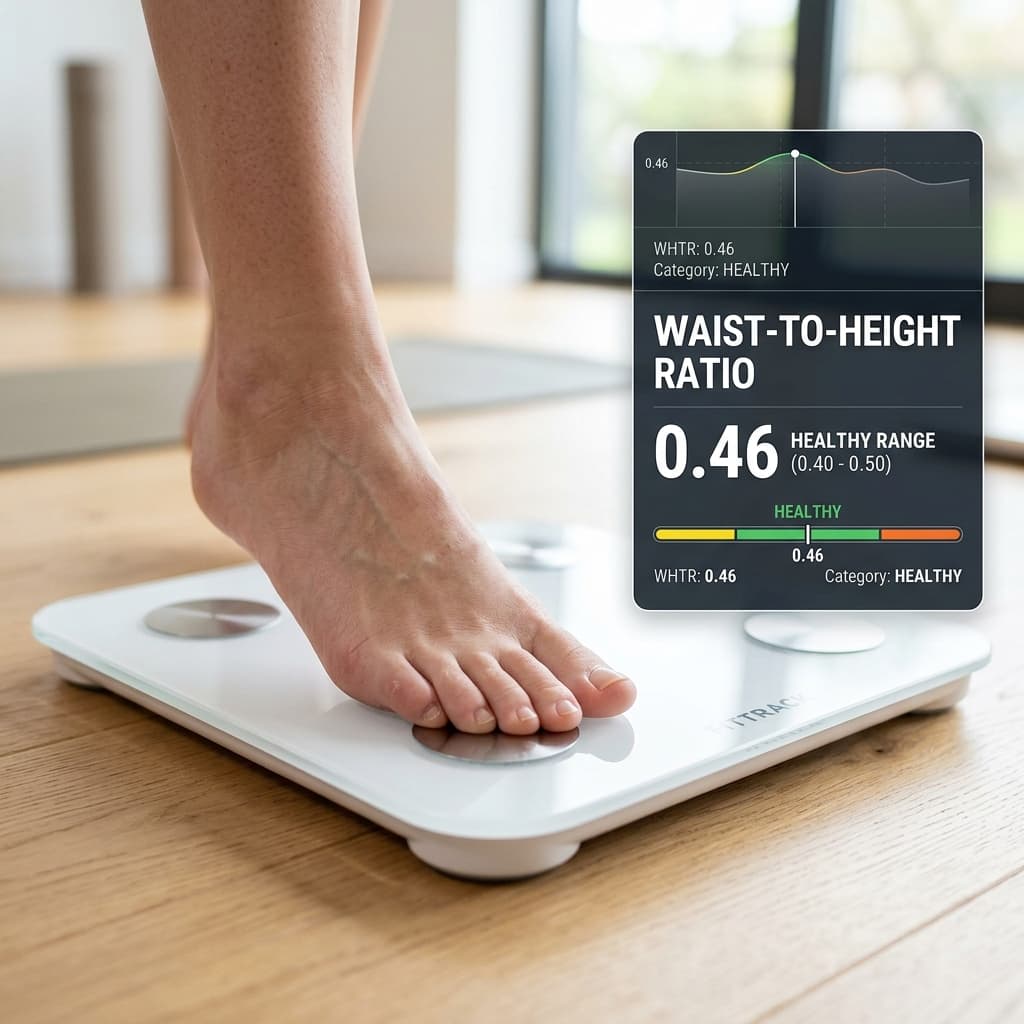
Calculate yours now with our waist-hip ratio calculator. For a complementary view using your height, try our waist-to-height ratio calculator.
How to Measure Waist and Hip Circumference
Waist measurement (WHO protocol):
- Stand upright, feet together, arms at sides
- Find the midpoint between the lower rib and the top of the iliac crest (hip bone)
- Measure horizontally at the end of a normal exhalation
- The tape should be snug but not compress tissue
- Do not measure at the narrowest point (this is "natural waist," not the WHO measurement site)
Hip measurement:
- Measure around the widest part of the buttocks
- Stand with feet together
- Tape should be horizontal and not too tight
WHR Risk Categories (WHO Guidelines)
| Category | Male WHR | Female WHR | Health Risk |
|---|---|---|---|
| Low Risk | ≤ 0.90 | ≤ 0.80 | Low cardiovascular risk |
| Moderate Risk | 0.91–1.00 | 0.81–0.85 | Increased metabolic risk |
| High Risk | > 1.00 | > 0.85 | Substantially elevated risk |
The female threshold is lower because women naturally have proportionally larger hips (gynoid fat distribution) at any given waist size. A WHR of 0.85 in a woman represents the same degree of central adiposity as a WHR of 1.00 in a man.
WHR vs. BMI vs. Waist-to-Height Ratio
These three measures capture different aspects of body composition and risk:
| Measure | What It Captures | CVD Prediction | Limitation |
|---|---|---|---|
| BMI | Total body mass/height | Moderate | Ignores fat distribution and muscle |
| WHR | Central vs. peripheral fat | Strong | Requires two measurements; hip measurement varies |
| Waist-to-Height | Abdominal fat relative to height | Strong | Single universal threshold (>0.5) may not apply equally to all ethnicities |
| Body Fat % | Actual fat mass fraction | Very Strong | Requires DEXA or accurate field methods |
Use all three together for the most complete picture. Check your body fat percentage and use our waist-to-height ratio calculator alongside your WHR for a multi-angle health assessment.
Body Shape and Health Risk
Body fat distribution patterns are strongly influenced by genetics, sex hormones, and age:
- Android (apple) shape: Fat predominantly stored in abdomen and trunk. More common in men and post-menopausal women. Associated with higher visceral fat accumulation and elevated risk of type 2 diabetes, cardiovascular disease, and metabolic syndrome.
- Gynoid (pear) shape: Fat predominantly stored in hips, buttocks, and thighs. More common in pre-menopausal women. Subcutaneous fat in these areas is metabolically less harmful and may even be modestly protective against cardiovascular disease in some research.
- Age and hormones: Estrogen promotes gynoid fat distribution in women. Post-menopause, the loss of estrogen shifts distribution toward android — explaining why cardiovascular risk increases sharply in women after menopause.
How to Reduce Waist-Hip Ratio
You cannot spot-reduce fat from the waist through targeted exercises. But visceral fat responds particularly well to specific interventions:
- Aerobic exercise: Visceral fat is disproportionately reduced by cardiovascular exercise compared to subcutaneous fat. 150–300 minutes/week of moderate aerobic activity produces significant visceral fat reduction independent of weight loss.
- Calorie deficit: A moderate calorie deficit (300–500 kcal/day below TDEE) reduces visceral fat preferentially in the early stages of weight loss, improving WHR before total weight loss becomes substantial.
- Reducing refined carbohydrates and added sugar: High-glycemic diets promote visceral fat deposition through insulin-driven lipogenesis. Replacing refined carbs with fiber-rich whole foods reduces visceral fat accumulation.
- Stress management and sleep: Chronically elevated cortisol drives visceral fat accumulation. Improving sleep quality and duration reduces cortisol levels and abdominal fat over time.
- Reducing alcohol: Alcohol is metabolized in the liver and promotes hepatic fat deposition, which contributes to visceral fat and worsens WHR.
Common WHR Mistakes
Measuring waist at the narrowest point
Many people instinctively measure at the narrowest part of the torso (the "natural waist"). The WHO protocol measures at the midpoint between rib and hip bone, which is typically wider. Using the narrowest point gives a misleadingly low WHR.
Measuring after a large meal
Abdominal bloating after eating can add 1–3 cm to waist circumference. For consistent tracking, measure first thing in the morning, fasted, after going to the bathroom.
Holding your breath or sucking in
Measure at the end of a normal exhalation, breathing normally. Holding your breath or actively pulling in the abdomen can reduce the measurement by 2–4 cm.
Tracking WHR weekly instead of monthly
Waist circumference fluctuates daily with water retention, digestion, and hormonal cycles. Monthly tracking after consistent measurement conditions gives a more meaningful trend signal than weekly readings.
WHR FAQs
Is waist-hip ratio better than BMI?
What is a healthy waist-hip ratio for women?
Can you have a healthy BMI but unhealthy WHR?
Does race/ethnicity affect WHR risk thresholds?
Written By
ToolsACE Editorial Team
Our editorial team researches and reviews health and fitness content with a focus on accuracy, clinical evidence, and practical application for everyday users.