BMR Calculator Guide: What Is Basal Metabolic Rate and Why It Matters
Your basal metabolic rate is the number of calories your body burns just to keep you alive — before any movement, exercise, or digestion. It is the baseline every diet plan must be built on.

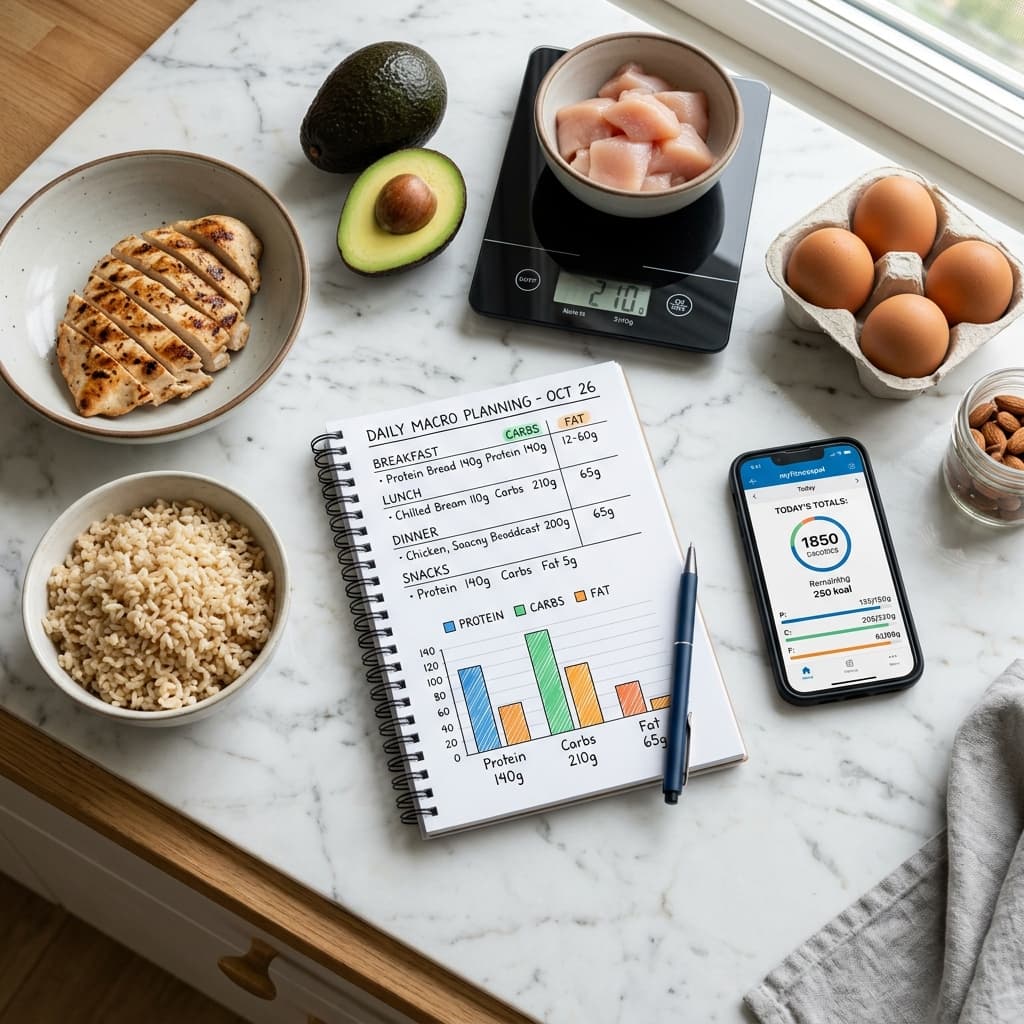
What Is BMR?
Basal Metabolic Rate (BMR) is the number of calories your body requires to maintain basic physiological functions while at complete rest — breathing, circulation, organ function, cell repair, and temperature regulation. It represents the minimum energy needed to keep you alive if you did nothing but lie still all day.
BMR accounts for 60–75% of total daily energy expenditure (TDEE) in sedentary individuals. Even before you take a single step, your body is burning the majority of its daily calories just sustaining vital processes. Understanding your BMR is the starting point for any accurate calorie plan.
Calculate yours in seconds: our BMR calculator uses both the Mifflin-St Jeor and Harris-Benedict formulas side by side.
BMR Formulas
Two equations dominate clinical and fitness use:
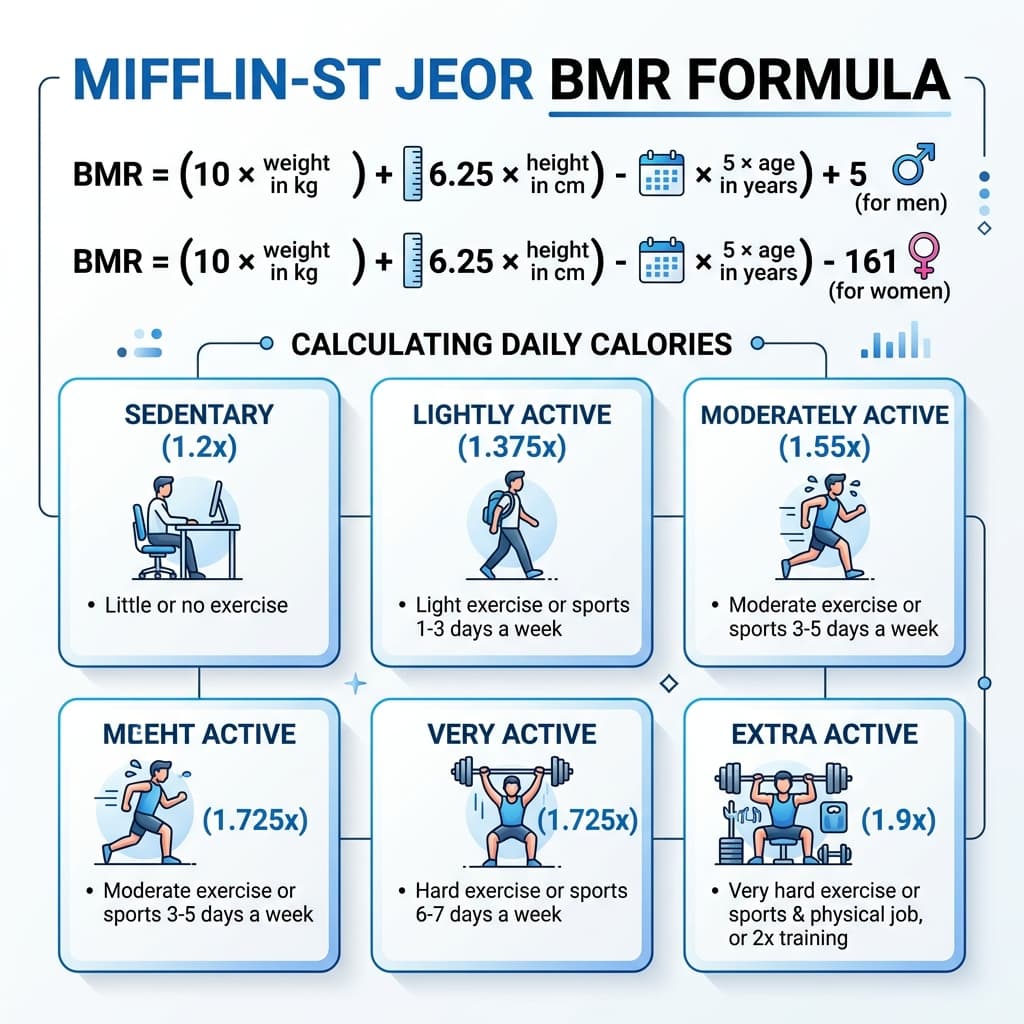
Mifflin-St Jeor (1990) — most accurate for most adults:
- Men: (10 × weight kg) + (6.25 × height cm) − (5 × age) + 5
- Women: (10 × weight kg) + (6.25 × height cm) − (5 × age) − 161
Harris-Benedict (revised Roza & Shizgal, 1984):
- Men: 88.362 + (13.397 × wt kg) + (4.799 × ht cm) − (5.677 × age)
- Women: 447.593 + (9.247 × wt kg) + (3.098 × ht cm) − (4.330 × age)
Example: A 30-year-old woman, 65 kg, 165 cm: Mifflin = 1,437 cal, Harris-Benedict = 1,459 cal. The 22-calorie difference is typical — both are clinically useful estimates.

Mifflin-St Jeor vs Harris-Benedict
Multiple validation studies have compared both formulas against measured resting energy expenditure (via indirect calorimetry). Mifflin-St Jeor consistently outperforms:
| Formula | Published | Mean Error | Best For |
|---|---|---|---|
| Mifflin-St Jeor | 1990 | ±5% | Most adults, overweight individuals |
| Harris-Benedict (revised) | 1984 | ±8% | Normal weight, athletic individuals |
| Katch-McArdle | 1975 | ±5% | Known lean body mass (most accurate) |
| Original Harris-Benedict | 1919 | ±10–15% | Outdated — do not use |
Use Mifflin-St Jeor as your default. If you know your body fat percentage and lean mass, Katch-McArdle is the most accurate of all three. Our BMR calculator supports all three formulas.
Factors That Affect BMR
- Body composition: Muscle tissue burns ~6 kcal/kg/day at rest; fat tissue burns ~2 kcal/kg/day. More muscle = higher BMR. This is the metabolic advantage of resistance training.
- Age: BMR decreases approximately 1–2% per decade after age 20 due to muscle loss (sarcopenia) and hormonal changes. A 60-year-old has roughly 8–16% lower BMR than a 20-year-old of the same weight.
- Sex: Men have 5–10% higher BMR than women of equal weight due to greater lean mass and higher testosterone levels. Formulas account for this with different constants.
- Thyroid function: The thyroid gland regulates metabolic rate. Hypothyroidism can reduce BMR by 30–40%; hyperthyroidism can raise it by 50–100%. Unexplained weight changes despite consistent eating warrant thyroid evaluation.
- Calorie restriction and adaptive thermogenesis: Prolonged calorie restriction reduces BMR beyond what is explained by weight loss alone — the body suppresses metabolic rate to conserve energy. This can reduce TDEE by 100–400 kcal/day after months of dieting.
- Temperature: Cold exposure slightly increases BMR through brown adipose tissue activation. Fever raises BMR approximately 7% per degree Fahrenheit of elevated body temperature.
BMR vs TDEE
BMR and TDEE are related but distinct. TDEE = BMR × activity multiplier. Your TDEE is what you actually burn in a day including all movement.
| Activity Level | Multiplier | TDEE Example (BMR 1,500) |
|---|---|---|
| Sedentary (desk job, no exercise) | × 1.2 | 1,800 cal |
| Lightly active (1–3 days/week) | × 1.375 | 2,063 cal |
| Moderately active (3–5 days/week) | × 1.55 | 2,325 cal |
| Very active (6–7 days/week) | × 1.725 | 2,588 cal |
| Extra active (physical job + daily training) | × 1.9 | 2,850 cal |
Build your full calorie plan from TDEE, not BMR. Use our TDEE calculator to go from BMR to your actual daily target in one step. Our calorie calculator then sets deficit or surplus targets based on your goal.
Using BMR for Your Goals
BMR defines the floor — you should never eat at or below your BMR without medical supervision. Eating at BMR level forces your body to cannibalize muscle for energy, suppresses thyroid function, and triggers hormonal disruption (reduced testosterone, disrupted leptin/ghrelin).
Practical guidelines:
- Fat loss: Create a deficit of 300–500 kcal/day below TDEE, not BMR. This produces 0.5–1 lb/week loss without the metabolic consequences of extreme restriction.
- Muscle gain: Eat 200–300 kcal/day above TDEE. Support with 0.7–1g protein per lb of bodyweight — use our protein calculator for exact targets.
- Maintenance: Eat at TDEE. Track for 2 weeks to verify — if weight drifts, adjust by 100–150 kcal increments.
Common BMR Mistakes
Using BMR as your calorie target
BMR is the energy needed for survival at rest. Eating at BMR is an extreme deficit that causes muscle loss, fatigue, and metabolic adaptation. Your deficit should be below TDEE, not below BMR.
Not recalculating after weight loss
BMR decreases as you lose weight — less body mass means less energy required for maintenance. A 20 lb weight loss typically reduces BMR by 100–150 kcal/day. Recalculate every 10–15 lbs of change.
Ignoring body composition
Two people with identical height, weight, age, and sex can have meaningfully different BMRs if their body fat percentages differ. A 180 lb person at 15% body fat has a noticeably higher BMR than a 180 lb person at 35% body fat.
Using the original 1919 Harris-Benedict formula
The original Harris-Benedict overestimates BMR by 10–15% compared to modern measurements. Many older sources and apps still use it. Always use the 1984 revised version or Mifflin-St Jeor.
BMR FAQs
What is a normal BMR for a woman?
Does muscle increase BMR?
Can you increase your BMR?
What is the difference between BMR and RMR?
Author Spotlight
The ToolsACE Team
ToolsACE is an independent platform founded in 2023 by a team of software developers and educators. We build free, privacy-first tools and write guides to help people make better decisions — without sign-ups, paywalls, or data tracking.