Loan Logic: How a Personal Loan / EMI Calculator Stops You from Overpaying
An EMI calculator turns three numbers into the most important figure for any borrower: the true monthly cost. Learn the formula, the inputs that matter most, and the prepayment levers that quietly save thousands.


The Cost of Borrowing Without Math
Most loan applications are signed on the strength of one number: the monthly EMI. If it fits the budget, the loan feels affordable. But the EMI is only the surface number — behind it sits a multi-year sequence of interest charges that, depending on rate and tenure, can quietly inflate the total cost by 40–80% over the principal you actually borrowed.
An EMI calculator surfaces that hidden cost in seconds. Three inputs — loan amount, interest rate, tenure — produce both the monthly payment and the total interest you will pay across the life of the loan. That second number is what stops bad borrowing decisions.
The ToolsACE EMI Calculator handles every common loan product in one place. For larger personal loans, the personal loan calculator adds processing fees and prepayment scenarios.
"The EMI tells you what you can afford monthly. The total interest tells you what the loan is actually costing you."
What an EMI Actually Is
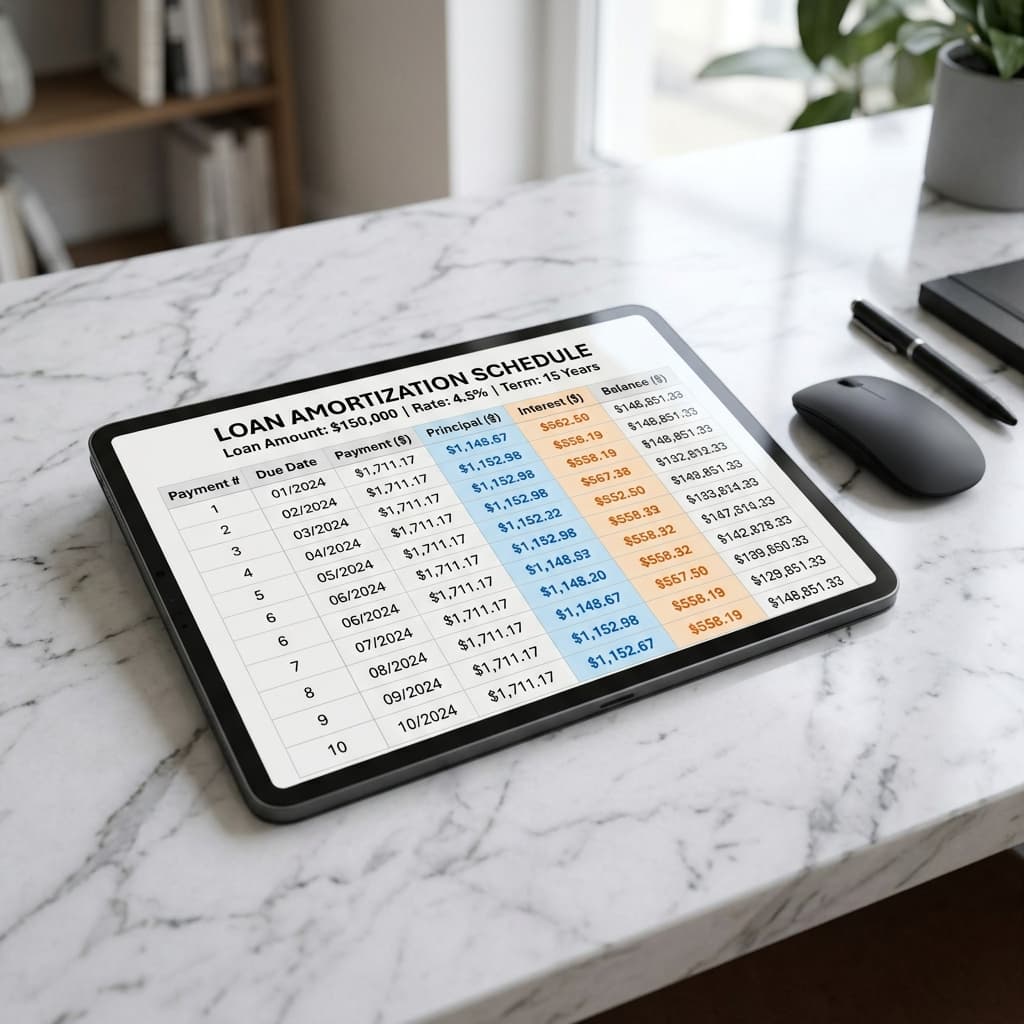
EMI stands for Equated Monthly Installment — a fixed payment that covers both interest and principal in a way that fully repays the loan by the final month. Early payments lean heavily toward interest; later payments tilt toward principal. The total stays constant.
Two practical implications follow from this:
- Long loans look cheap monthly but cost more lifetime. Doubling the tenure roughly halves the EMI but can more than double the total interest.
- Early prepayments hit principal hardest. An extra payment in year 1 saves you years of compounding interest. The same payment in year 5 saves dramatically less.
Understanding this is the difference between a loan you control and a loan that controls you.
The EMI Formula
Equated Monthly Installment
EMI = P × r × (1+r)n / [(1+r)n − 1]
P = principal · r = monthly interest rate (annual / 12 / 100) · n = number of monthly installments (years × 12)
So a $20,000 personal loan at 12% over 5 years works out to about $444.89 per month, with a total payback of roughly $26,693 — meaning $6,693 of pure interest on a $20,000 loan. Drop the rate to 9% and the EMI falls to $415, total interest $4,910 — nearly $1,800 saved on the same loan amount.
That spread is what calculator-driven rate shopping is worth. Run two or three lender quotes through the calculator before you sign anything.
Inputs That Move the Number
In rough order of impact:
- Interest rate. Tiny percentage shifts move the lifetime interest by hundreds or thousands. Always shop at least three offers.
- Tenure. Longer tenure lowers the EMI but raises the total interest. Pick the shortest tenure your monthly budget can comfortably absorb.
- Loan amount. Borrow only what you actually need — rounding up "just in case" quietly adds years of interest.
- Processing fee & insurance. Often 1–3% of the loan, deducted up front. Add it to the principal in the calculator to see the true effective rate.
- Prepayment penalty. Some lenders charge 2–4% on early payoff. Always read the prepayment clause.
Personal, Student & Auto Loans
The EMI formula is universal, but the surrounding terms differ:
- Personal loan — unsecured, higher rate (10–20%+), short tenure (1–5 years). Use the personal loan calculator.
- Auto loan — secured by the vehicle, mid rate (6–12%), tenure 3–7 years. Beware of long tenures — cars depreciate faster than the loan amortises.
- Student loan — subsidised, often deferred. Use the student loan calculator and the student loan forgiveness calculator to model income-driven repayment.
- Home loan — longest tenure, lowest rate, biggest lifetime interest impact. Covered in detail in our mortgage calculator guide.
- Credit card debt — not technically EMI, but the credit card payoff calculator models the same principal-and-interest payoff math.
Compare Two Lenders
Run both offers side by side. The cheaper EMI sometimes hides a longer tenure — check total interest, not just monthly cost.
Read the Prepayment Clause
A 2–4% prepayment penalty can quietly erase years of would-be interest savings. Negotiate it down if you can.
Pay It Off Faster
The same calculator that shows the cost of borrowing also models the savings from accelerated payoff. Three levers cover almost every situation:
- Round up the EMI. If your EMI is $444, paying $500 each month directs the extra $56 straight at principal. On a 5-year personal loan, that often saves a full year of payments.
- Annual lump sum. Direct annual bonuses, tax refunds, or windfalls at the principal. Run the scenario in the calculator first to confirm the lender will apply it correctly.
- Refinance. If rates fall significantly, a balance transfer to a lower-rate lender can cut total interest. Account for processing fees on the new loan and prepayment penalty on the old one.
For credit card balances specifically, the credit card payoff calculator models snowball vs. avalanche strategies — both work, but avalanche (highest-rate first) saves more interest while snowball (smallest-balance first) often wins on motivation.
A Smart Borrower’s Routine
Run Three Lender Scenarios Before Applying
Plug your loan request into the calculator at each lender’s rate. The total-interest column is your real comparison — not the EMI.
Test Two Tenures Side by Side
Compare a 3-year vs. 5-year EMI for the same loan. Pick the shortest tenure your monthly cash flow can absorb without strain.
Set a Round-Up Auto-Payment
Pay even $20–$50 above the EMI and direct it at principal. The compounding savings show up in the calculator immediately.
Re-Check Annually
Once a year, plug your remaining balance into the calculator at current rates. If a refinance saves more than the fees, talk to lenders.
Loan Math Reality:
3% Rate Drop on $20k / 5y
~$1.8k interest saved
EMI Round-Up of $50
~10 mo off the term
Loan Calculator FAQs
What is a good interest rate for a personal loan?
Should I pick a longer tenure to reduce EMI?
Are EMI calculators accurate?
Should I prepay my loan or invest the extra money?
Does prepaying a loan hurt my credit score?
Author Spotlight
The ToolsACE Team
ToolsACE is an independent platform founded in 2023 by a team of software developers and educators. Our editorial team writes, researches, and reviews every article and tool guide on this site. We built ToolsACE because we were frustrated by tools that required sign-ups, tracked your data, or hid answers behind paywalls.