Calorie Deficit Calculator Guide: How Much to Cut and How Fast to Lose
A calorie deficit is the only mechanism of fat loss — but the size of that deficit determines whether you lose fat quickly, lose muscle, or stall entirely. Here is how to get it right.


What Is a Calorie Deficit?
A calorie deficit means you consume fewer calories than your body burns in a day. When that gap exists, the body must source the remaining energy from stored tissue — primarily body fat, but also muscle if protein intake is too low or the deficit is too aggressive.
The math is simple: 3,500 calories = approximately 1 lb (0.45 kg) of body fat. A daily deficit of 500 calories should yield roughly 1 lb of fat loss per week. In practice, water fluctuations, hormonal changes, and metabolic adaptation make week-to-week results messier than this — but the rule holds over multi-week averages.
Start by finding your maintenance level with our TDEE calculator, then subtract your target deficit from that number to get your daily calorie goal. Our calorie calculator can also give you goal-adjusted targets directly.
"A deficit of 500 calories/day produces roughly 1 lb/week of fat loss over time — but only if protein is high enough to preserve the muscle underneath."
How Big Should Your Deficit Be?
Deficit size is a tradeoff between speed and muscle preservation. Larger deficits lose weight faster but increase the proportion of muscle lost and trigger stronger hunger and fatigue. Smaller deficits are slower but sustainable and muscle-sparing.
| Deficit Size | Expected Loss | Best For | Risk |
|---|---|---|---|
| Small (200–300 kcal) | 0.4–0.6 lb/week | Athletes, recomp, last 10 lbs | Very slow; hard to stay consistent |
| Moderate (400–600 kcal) | 0.8–1.2 lb/week | Most people — sweet spot | Minimal if protein is adequate |
| Large (700–1,000 kcal) | 1.4–2 lb/week | High starting body fat (>30%) | Muscle loss risk; hunger; fatigue |
| Aggressive (>1,000 kcal) | Variable — metabolic slowdown | Medically supervised only | High: muscle loss, nutrient deficiency, rebound |
Floor rule: never eat below 1,200 kcal (women) or 1,500 kcal (men) without medical supervision. Below these levels, meeting minimum protein and micronutrient needs becomes nearly impossible.
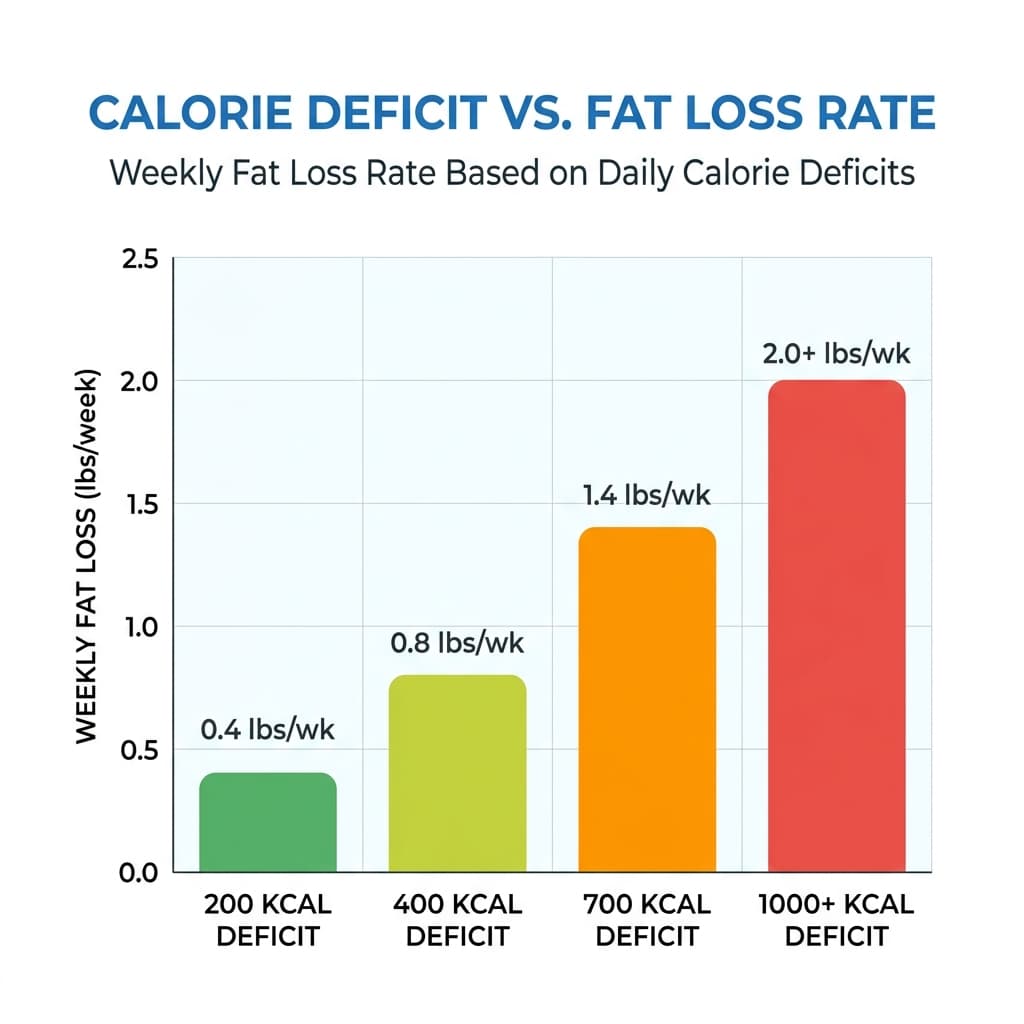
Expected Rate of Loss at Different Deficits
The 3,500 kcal/lb rule is a useful starting estimate, but actual fat loss varies by individual. People with higher body fat percentages lose faster; leaner individuals lose more slowly and risk more muscle loss at the same deficit.
A more accurate modern estimate accounts for body composition: 1% of bodyweight per week is a widely used upper limit for fat loss while preserving muscle. For a 200 lb person, that is 2 lbs/week maximum. For a 140 lb person, it is 1.4 lbs/week.
- Losing more than 1% bodyweight/week consistently → likely losing muscle
- Losing less than 0.3% bodyweight/week → deficit is too small or inconsistently applied
- Scale weight flat but waist shrinking → body recomposition, trust the tape measure
- Scale weight flat and no changes → deficit needs verification (food logging accuracy)
Protein on a Cut: The Non-Negotiable
In a calorie deficit, your body is in an energy-deprived state. Without adequate protein, it turns to muscle as a secondary fuel source. This is called muscle catabolism — and it permanently lowers your Basal Metabolic Rate, making future fat loss harder.
Research consistently shows that 0.7–1.0g of protein per pound of bodyweight (1.6–2.2g/kg) during a deficit is sufficient to preserve lean mass. This is higher than typical "general health" protein recommendations because the deficit itself increases muscle breakdown risk.
Practical targets:
- 150 lb person: 105–150g protein/day minimum while cutting
- 180 lb person: 126–180g protein/day minimum while cutting
- 220 lb person: 154–220g protein/day minimum while cutting
Use our protein calculator to get your exact gram target based on body weight and goal.
Hitting a Plateau
A plateau — two or more weeks of no progress despite consistent effort — is almost always one of three things:
- Calorie logging error: Studies show people underestimate calorie intake by 20–40% on average. Weigh food instead of measuring by volume for 1–2 weeks and you will almost always find the gap.
- Metabolic adaptation: After weeks of dieting, your body burns fewer calories doing the same activities. Your original TDEE is now overstated. Recalculate — or take a maintenance week to restore metabolic rate before resuming the deficit.
- Weight is not the right metric: If you are strength training and the scale stalls but measurements decrease, body recomposition is happening. The scale is misleading; body fat percentage and measurements are better indicators.
Before cutting calories further, verify food logging accuracy for 5–7 days. Reducing calories further when the real issue is logging error just accelerates muscle loss and fatigue.
Realistic Weight Loss Timeline
| Goal (lbs to lose) | At 0.5 lb/week | At 1 lb/week | At 1.5 lb/week |
|---|---|---|---|
| 10 lbs | 20 weeks | 10 weeks | 7 weeks |
| 20 lbs | 40 weeks | 20 weeks | 13 weeks |
| 30 lbs | 60 weeks | 30 weeks | 20 weeks |
| 50 lbs | 100 weeks | 50 weeks | 33 weeks |
These are linear estimates. Real timelines include plateaus, diet breaks, and metabolic adaptation — budget 20–30% extra time on top of linear projections for a realistic target date.
Deficit Mistakes to Avoid
Eating back all exercise calories
Your TDEE already accounts for exercise via its activity multiplier. Eating back Fitbit-estimated burn on top of TDEE creates a double-count that erases your deficit entirely.
Starting too aggressively
A 1,000+ calorie deficit in week one triggers intense hunger, mood shifts, and energy crashes that cause most people to quit within 2–3 weeks. Start at 300–500 and let your body adjust over 2 weeks before tightening.
Never recalculating
Your TDEE falls as you lose weight. A deficit calculated at 220 lbs is no longer accurate at 190 lbs — you may have drifted to maintenance without realising it. Recalculate every 10–15 lbs lost.
Too little protein
The fastest way to fail a cut: run a large deficit with inadequate protein. You will lose weight but up to 40% of it may be muscle — destroying the physique you are trying to uncover.
Binary dieting (all-or-nothing)
One high-calorie day does not ruin a week of progress. What ruins progress is the cognitive distortion that treats one slip as license to abandon the plan entirely. A single 500-calorie surplus cancels out one day — not the month.
Calorie Deficit FAQs
Is a 500-calorie deficit safe every day?
Can I maintain muscle in a calorie deficit?
Why am I not losing weight in a deficit?
Should I take diet breaks?
Does cutting carbs or fat matter more than total calories?
Author Spotlight
The ToolsACE Team
ToolsACE is an independent platform founded in 2023 by a team of software developers and educators. We build free, privacy-first tools and write guides to help people make better decisions — without sign-ups, paywalls, or data tracking.