Home Remodeling Budget Calculator: How to Plan Any Renovation Without Overspending in 2026
Remodeling budgets blow out because of unknown unknowns. Learn to calculate materials, labor, and contingency buffers for any renovation project.


Budget Basics
The average home renovation runs 20–40% over initial budget. This isn't primarily due to contractor fraud or scope changes — it's the result of systematic underestimation of three budget categories: labor costs (most people budget materials but not installation), hidden conditions (asbestos, rotted subfloor, outdated wiring discovered mid-project), and finish selection (budgeting builder-grade but buying mid-grade).
Accurate renovation budgeting requires calculating materials independently using measurements and cost-per-unit figures, then adding labor as a percentage of materials cost for each trade, then adding a structured contingency buffer based on project complexity and age of the home. This guide shows you how to use ToolsACE's construction calculators to build a defensible estimate before you talk to a single contractor.
Start with our wall square footage calculator for room measurements, gallons per square foot calculator for paint quantity, or concrete calculator for concrete work — each generates precise material quantities from your room dimensions.
"Know your material quantities before you get bids. Contractors who see an informed client give tighter estimates and fewer surprises."
Cost Per Square Foot: Benchmarks for 2026
Cost-per-square-foot benchmarks give you a sanity check for contractor bids. National averages in 2026 (materials + labor, mid-range finishes):
2026 Renovation Cost Benchmarks (Mid-Range):
Hardwood flooring (install)
$8–15 per sq ft
Tile (install)
$10–20 per sq ft
Interior painting
$2–5 per sq ft
Full kitchen remodel
$150–300 per sq ft
Use these benchmarks to evaluate bids — a bid significantly below benchmark often indicates missing scope, low-quality materials, or unlicensed labor. A bid significantly above benchmark requires justification: premium finishes, complex structural work, or unusually high local labor rates.
Kitchen vs Bathroom: Budget Allocation
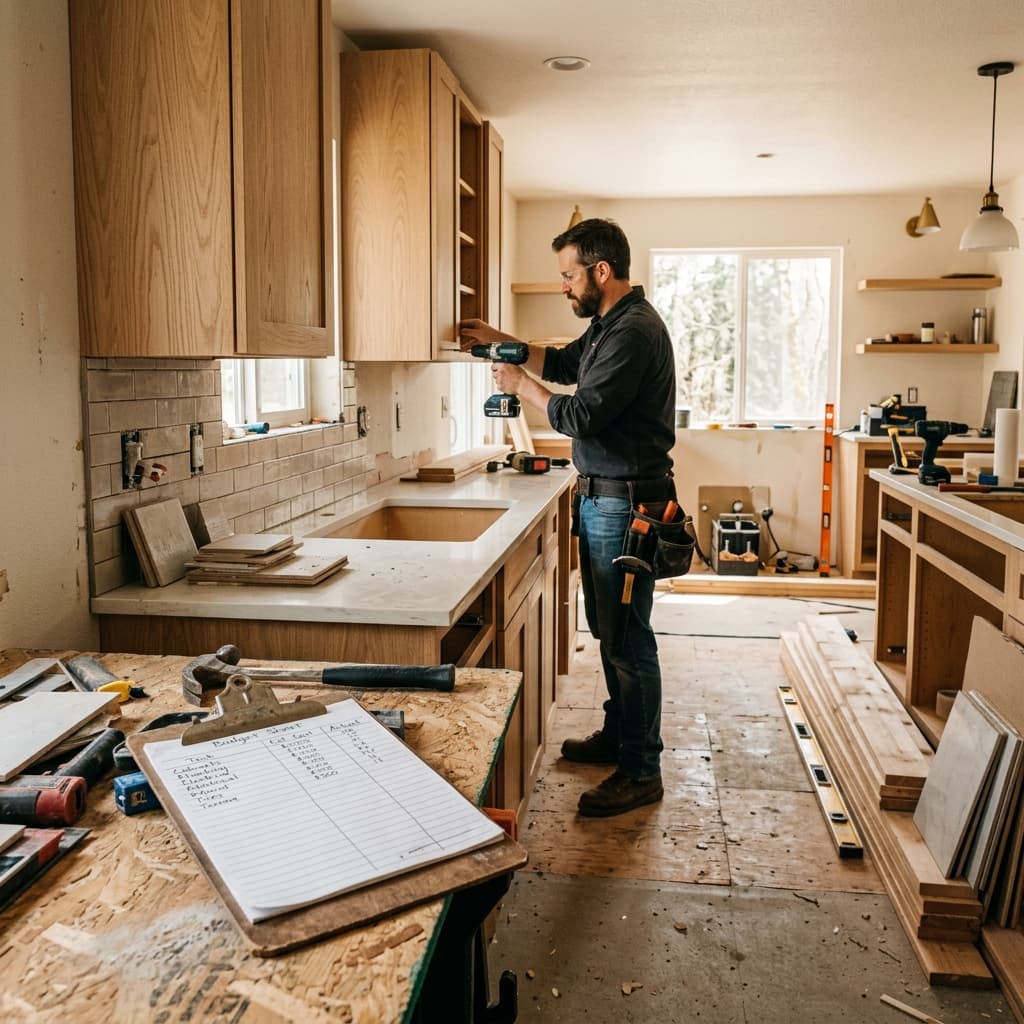
Kitchen and bathroom renovations are the most popular remodeling projects. Budget allocation (how you split the total between materials, labor, and finishes) differs significantly between the two.
- Kitchen renovation (typical $25,000–$75,000): Cabinets 35–45% of budget, countertops 10–15%, appliances 15–20%, labor (plumbing, electrical, installation) 30–35%, flooring 5–10%. The biggest budget lever: cabinet quality. Stock cabinets ($5,000–10,000) vs semi-custom ($15,000–25,000) vs custom ($25,000–50,000) is the single largest cost variable.
- Bathroom renovation (typical $10,000–$35,000): Tile 20–30% of budget, fixtures (toilet, vanity, tub/shower) 25–35%, labor (plumbing, tile installation) 40–50%. Tile labor is the dominant cost because of time intensity — calculate your tile square footage using the concrete calculator before getting bids.
ROI on Renovations: What Actually Adds Value
High ROI Projects
Garage door replacement (102% ROI), manufactured stone veneer (97%), minor kitchen remodel ($25K budget: 86%), deck addition (82%), entry door replacement (80%). These projects recover most or all of their cost at resale.
Lower ROI Projects
Master suite addition (57%), major kitchen remodel (58%), backyard patio (57%), bathroom addition (50%). These add significant value to daily living but recover less than 60 cents per dollar at resale. Better to choose based on personal value, not investment logic.
ROI data from the Remodeling Magazine Cost vs Value Report. Regional variation is significant — coastal metros and hot housing markets generally show higher ROI than average for all renovation types. Track your renovation budget and break-even using our budget planner alongside your local home value data.
Materials Math: Calculate Before You Buy
Flooring: Area + 10% Waste
Measure the room length × width to get square footage. Add 10% for standard cuts and waste (15% for diagonal installations, 10% for tile patterns). Use the flooring calculator to convert square footage to boxes/planks based on your product's coverage per unit.
Paint: Two Coats, Subtract Openings
Calculate total wall area (perimeter × ceiling height), subtract doors (21 sq ft each) and windows (15 sq ft each). Divide by 350–400 sq ft per gallon for most paints. Multiply by 2 for two coats. The paint calculator handles this automatically and adjusts for primer coat requirements.
Tile: Area + 10–15%, Grout Included
Calculate floor or wall area in square feet. Add 10% for standard layouts or 15% for diagonal or herringbone patterns. Tile area also determines grout quantity — typical ratio is 1 lb of grout per 2 sq ft for 12×12 tile with 1/8" joints.
Remodeling FAQs
How much contingency should I budget for a renovation?
When should I DIY vs hire a contractor?
How do I get accurate contractor bids?
Author Spotlight
The ToolsACE Team
ToolsACE builds free construction and home improvement calculators for homeowners, contractors, and designers who need accurate quantities and cost estimates without subscription fees.