How Long Should a Tie Be? Expert Tips for Perfect Length
One rule governs tie length across every knot, every occasion, and every body type. Here's the exact benchmark — and the adjustments that matter for height and knot style.


The Belt-Buckle Rule
There is one universal standard for tie length: the tip of the tie (the front blade) should reach the middle of your belt buckle. Not above it. Not below it. Exactly at the horizontal center.
This rule applies regardless of knot type, occasion formality, or body proportions. It is the benchmark from which all other adjustments are made.
"A tie tip that dangles below the belt buckle reads as careless. One that stops too high reads as ill-fitting. The buckle center is the target — every time."
Standard Tie Length
Most ties sold off-the-rack are 57–58 inches (145–147 cm) long. This is calibrated for a man of average height (5'8"–5'11") tying a Four-in-Hand knot with a standard shirt collar.
| Height | Recommended Tie Length | Notes |
|---|---|---|
| Under 5'6" (168 cm) | 54–56 in (137–142 cm) | Short/petite ties available |
| 5'6"–5'11" (168–180 cm) | 57–58 in (145–147 cm) | Standard retail length |
| 6'0"–6'3" (183–190 cm) | 59–61 in (150–155 cm) | Tall/extra-long ties |
| Over 6'3" (190 cm) | 62–64 in (157–163 cm) | XL ties from specialist retailers |
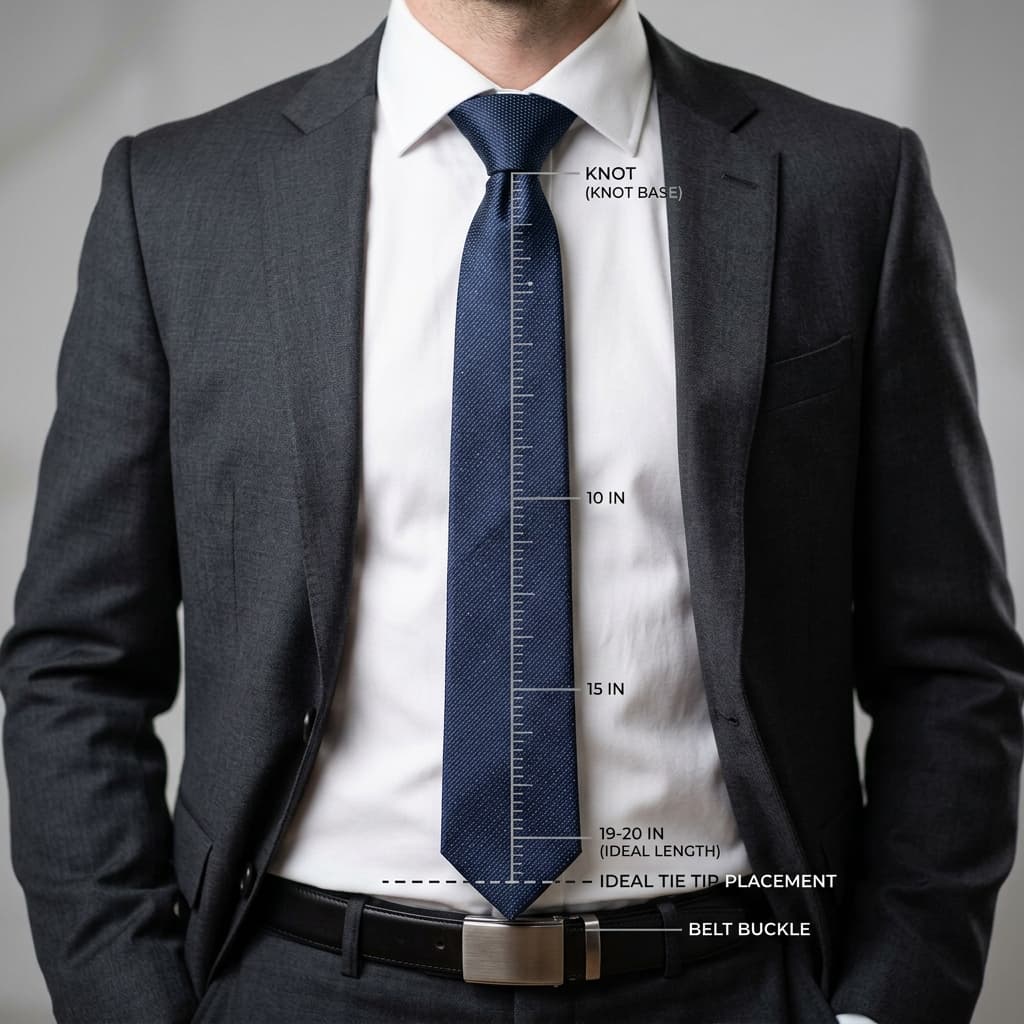
Adjusting for Your Height
Height determines how much tie length is consumed by the drop from collar to belt. Taller men need longer ties to reach the belt buckle after tying the knot; shorter men need less.
- Short men (under 5'6"): Standard 57" ties leave too much excess. Look for 54" petite ties, or tie larger knots (Half-Windsor) to consume more length.
- Average men (5'6"–5'11"): Standard 57–58" ties work perfectly with a Four-in-Hand.
- Tall men (over 6'0"): Standard ties will land 1–3 inches above the buckle. Seek 60–64" ties from specialist retailers.
Knot Type Changes Required Length
Different knots consume different amounts of tie fabric. A larger knot uses more length — which means your tie tip ends up shorter than with a small knot using the same tie.
- Four-in-Hand (small knot): Uses least fabric. Works with standard 57–58" ties for most heights.
- Pratt/Shelby (medium): Consumes ~1 inch more than Four-in-Hand. Taller men may need 59"+.
- Half-Windsor (medium-large): Uses 2–3 inches more. Shorter men can use this to shorten apparent tie length.
- Full Windsor (large): Consumes the most length. Best paired with a 59–61" tie for average heights.
Tie Width Guide
Width is as important as length for a polished look. The general rule: tie width should match lapel width.
- Slim ties (2–2.5"): Pair with slim lapels and narrow-cut suits. Modern/fashion-forward aesthetic.
- Standard ties (3–3.5"): The classic width. Works with most business suits and medium lapels.
- Wide ties (3.5–4"+): Pair with wide lapels. Traditional/power dressing aesthetic, classic for formal events.
Bow Tie Length
Pre-tied bow ties come in a fixed size, typically adjustable from 14–18" neck circumference. Self-tie bow ties are cut to ~44–48" to allow for tying. Neither follows the belt-buckle rule — bow ties sit at the collar and don't hang down.
For self-tie bow ties: wider necks need the bow tie centered higher on the adjustment band before tying. The tied bow should be approximately as wide as the widest part of your shirt collar spread.
Tie FAQs
What if my tie is too long after tying?
Should the back blade of the tie show?
Is there a rule about the tie and vest/waistcoat?
Can I wear a tie pin to fix length issues?
Author Spotlight
The ToolsACE Team
ToolsACE is an independent platform founded in 2023 by a team of software developers and educators. We build free, privacy-first tools and write guides to help people make better decisions — without sign-ups, paywalls, or data tracking.