Sleep Debt Calculator Guide: Measure and Recover Your Missing Sleep
Most adults carry a chronic sleep debt they do not realise is quietly raising their cortisol, storing more body fat, and impairing every cognitive task they attempt. Here is how to measure it and what the science actually says about paying it back.

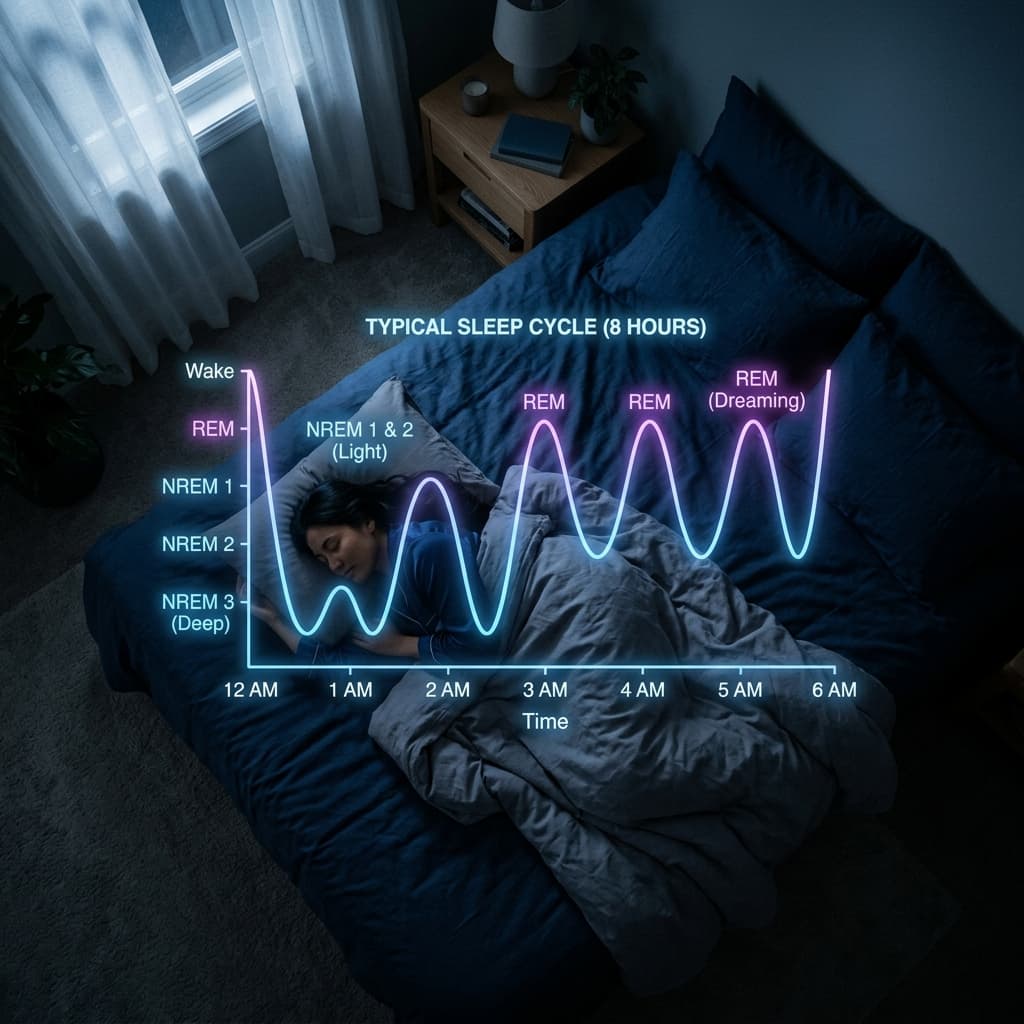
What Is Sleep Debt?
Sleep debt is the cumulative shortfall between the sleep your body needs and the sleep you actually get. It is not a metaphor — sleep research shows that the impairments from insufficient sleep compound over consecutive nights in a dose-response relationship, just as a financial debt accumulates interest.
The concept of a fixed "sleep need" varies by individual, but the scientific consensus for adults is 7–9 hours per night. The U.S. CDC classifies fewer than 7 hours as insufficient for most adults. Sleeping 6 hours when your body needs 8 creates a nightly debt of 2 hours. Over a 5-day workweek, that is 10 hours of sleep debt — equivalent to roughly two full nights of total sleep deprivation in terms of cognitive impact.
Track your weekly sleep hours and calculate your running deficit using our sleep debt calculator.
"After two weeks of sleeping 6 hours per night, performance on cognitive tests is equivalent to going 48 hours without sleep — yet most people do not notice, because chronic sleepiness distorts self-assessment."
— Van Dongen et al., Sleep, 2003
How to Calculate Your Sleep Debt
Simple formula: Sleep Debt = (Your Sleep Need × Days) − Actual Sleep Logged
Example: You need 8 hours. Over 7 days you slept: 6, 6, 7, 5.5, 6, 8, 7 = 45.5 hours total. Your need was 56 hours. Sleep debt: 10.5 hours.
| Nightly Shortfall | Weekly Debt | Monthly Debt | Risk Level |
|---|---|---|---|
| 30 min/night | 3.5 hrs | 15 hrs | Low |
| 1 hr/night | 7 hrs | 30 hrs | Moderate |
| 1.5 hrs/night | 10.5 hrs | 45 hrs | High |
| 2+ hrs/night | 14+ hrs | 60+ hrs | Severe |
Determining your personal sleep need: track 2 weeks where you go to bed when sleepy and wake naturally without an alarm (e.g., a vacation). Average the last 5 nights — that is your natural sleep need without debt repayment inflating early nights.
What Sleep Debt Does to Your Body
Sleep deprivation research has documented a cascade of physiological effects that extend well beyond feeling tired. The most significant:
- Cortisol elevation: Chronic sleep restriction raises evening cortisol, the primary stress hormone. Elevated cortisol promotes visceral fat storage and suppresses immune function.
- Ghrelin up, leptin down: Just two nights of sleeping 4 hours each is enough to raise ghrelin (hunger hormone) by 28% and reduce leptin (satiety hormone) by 18% — creating a state of physiological hunger regardless of actual caloric needs.
- Insulin sensitivity drops: One week of sleeping 5 hours reduces insulin sensitivity by ~25%, a change comparable to gaining 20–30 lbs of fat. This directly raises type 2 diabetes risk.
- Cognitive impairment: Working memory, reaction time, decision-making, and emotional regulation all degrade measurably after consecutive nights of sub-7-hour sleep.
- Testosterone reduction: Sleeping fewer than 5 hours for one week reduces testosterone by 10–15% in men — equivalent to aging 10–15 years hormonally.
- Immune suppression: Sleeping 6 hours or fewer quadruples the likelihood of catching a cold when exposed to rhinovirus compared to sleeping 8+ hours (Cohen et al., 2015).
Can You Repay Sleep Debt?
The evidence is nuanced. Short-term acute debt (1–3 nights) is largely recoverable within a few nights of extended sleep. Reaction time, mood, and alertness return close to baseline after 1–2 recovery nights.
Chronic debt — accumulated over weeks, months, or years — is harder to fully reverse. Key findings:
- Metabolic and hormonal impairments from chronic restriction recover with recovery sleep, but may take weeks, not days
- Cognitive performance recovers more slowly than subjective sleepiness — you may feel recovered while performing well below baseline
- Weekend "catch-up" sleep partially addresses short-term acute debt but does not cancel the metabolic damage from consistent weekday restriction
- The most effective strategy: gradually extend nightly sleep duration to meet your need consistently, rather than irregular binge-sleeping on weekends
Recovery Protocol
If you have significant sleep debt, trying to "pay it all back at once" backfires — oversleeping disrupts your circadian rhythm and causes next-day grogginess (sleep inertia). The evidence-based approach:
Extend bedtime by 30 minutes
Move your sleep window earlier — not your wake time later. Keeping wake time consistent anchors your circadian rhythm and helps your body actually feel tired at the new earlier bedtime.
Hold the extended time for 2 weeks
It takes roughly 2 weeks of consistent earlier bedtimes for the circadian rhythm to fully shift. Resist the urge to drift back on weekends.
Add another 15–30 minutes if still fatigued
After 2 weeks, assess. If you are still waking to an alarm feeling unrested, extend another 15–30 minutes. Repeat until you are waking naturally before the alarm.
Short naps are permitted (under 30 min)
A 10–20 minute nap before 3 PM reduces acute sleepiness without disrupting nighttime sleep. Avoid naps after 3 PM — they reduce sleep pressure and make falling asleep at night harder.
Track recovery with a sleep log
Log actual sleep each morning and calculate your running debt. Most people need 2–4 weeks of consistent extended sleep to clear a significant chronic debt.
Track your sleep patterns and use our REM sleep calculator to plan sleep windows that optimize full sleep cycles.
Sleep Debt and Body Fat
Sleep deprivation is one of the most underappreciated drivers of body fat accumulation. The mechanism is hormonal, not motivational: ghrelin elevates, leptin drops, cortisol rises, insulin sensitivity falls — creating a physiological environment that makes fat storage easier and fat loss harder, regardless of diet and exercise effort.
People sleeping 5–6 hours consume an average of 300–550 extra calories per day compared to when they sleep 8–9 hours, primarily from late-night snacking driven by elevated ghrelin. Over weeks, this additional intake easily overwhelms a moderate calorie deficit.
If fat loss is your goal and you are sleeping fewer than 7 hours, fixing sleep should be treated as a higher priority than adjusting macros. Check your current body fat percentage with our body fat calculator and revisit it after 4 weeks of improved sleep — the improvement is often measurable.
Sleep Hygiene Fundamentals
Sleep hygiene refers to the set of environmental and behavioural practices that improve sleep quality and duration. The evidence base here is well-established:
- Consistent sleep/wake times (±30 min): The single most impactful habit. Irregular schedules fragment circadian rhythm and reduce sleep quality even when total hours are adequate.
- Room temperature 65–68°F (18–20°C): Core body temperature must drop 1–3°F to initiate and maintain deep sleep. A cool room accelerates this.
- Total darkness: Even dim light exposure suppresses melatonin. Blackout curtains or a sleep mask measurably improve sleep architecture.
- No screens 60 minutes before bed: Blue light from screens delays melatonin secretion by 1–3 hours at high exposures. Blue-light glasses reduce but do not eliminate this effect.
- No caffeine after 2 PM: Caffeine has a half-life of 5–7 hours. A coffee at 3 PM leaves 50% of the caffeine active at 9 PM, directly reducing slow-wave sleep.
- Alcohol disrupts sleep architecture: Alcohol sedates but suppresses REM sleep. Even 2–3 drinks meaningfully degrades sleep quality in the second half of the night.
Sleep Debt FAQs
How long does it take to recover from sleep debt?
Is sleeping 6 hours really that bad?
Does napping count toward sleep debt repayment?
I sleep 7 hours but still feel tired — why?
Can tracking apps accurately measure sleep debt?
Author Spotlight
The ToolsACE Team
ToolsACE is an independent platform founded in 2023 by a team of software developers and educators. We build free, privacy-first tools and write guides to help people make better decisions — without sign-ups, paywalls, or data tracking.