TDEE & Macro Calculator Guide: Set Your Calories and Macros Right
Knowing your Total Daily Energy Expenditure is the single most important number in nutrition. Get it wrong and every macro split built on top of it is wrong too. Here's exactly how to calculate it — and what to do next.

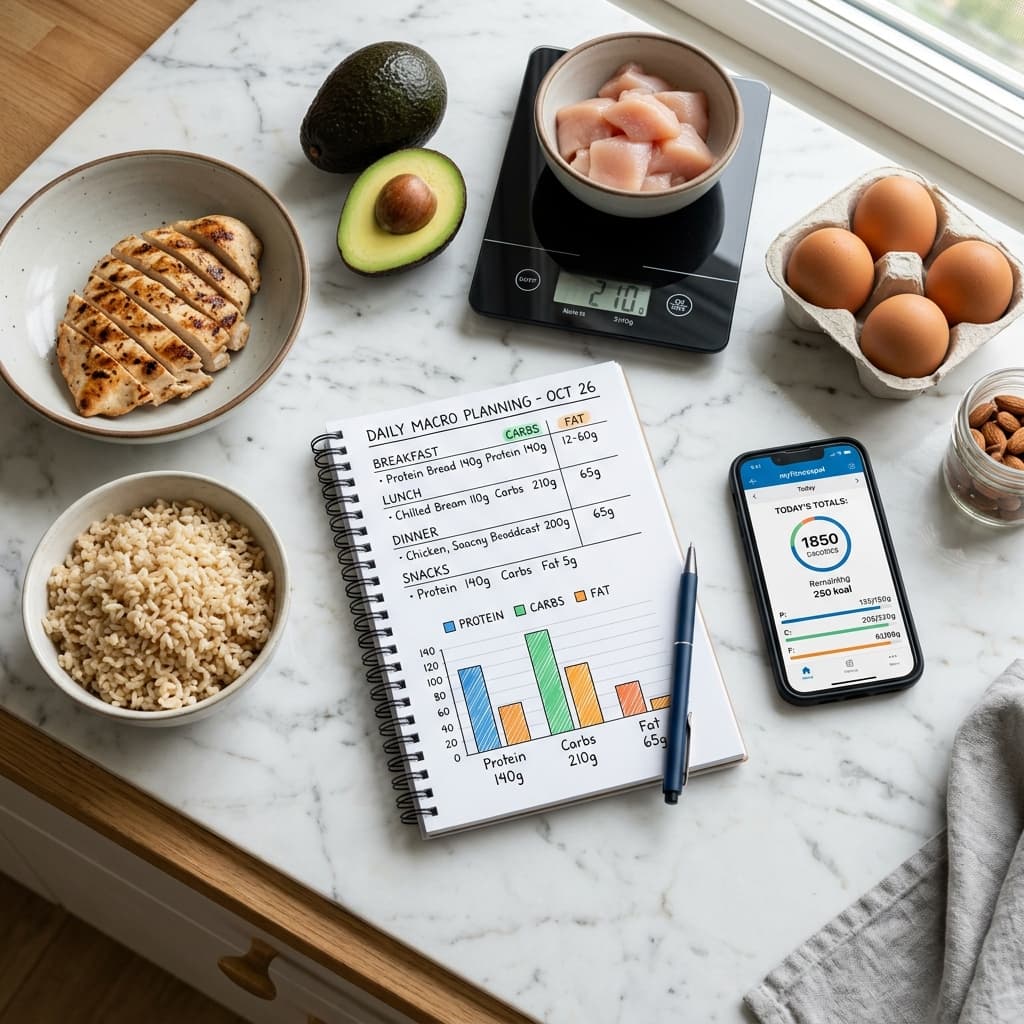
What Is TDEE?
Your Total Daily Energy Expenditure (TDEE) is the number of calories your body burns in a full day — not just at rest, but including every movement: walking to your car, typing, working out, even digesting food. It is the true ceiling above which you gain weight and below which you lose it.
Most people use Basal Metabolic Rate (BMR) and TDEE interchangeably. They are not the same thing. BMR is the energy your body uses to keep you alive if you literally stayed in bed all day. TDEE multiplies BMR by an activity factor to account for real life. Eating at BMR level when you exercise daily will stall your progress.
The fastest way to find your number: use our TDEE calculator, which uses the Mifflin-St Jeor equation (the most validated formula for most adults) and adjusts for your activity level in one step.
"TDEE is the single number every diet plan should be built around. Ignore it and you're guessing. Calculate it and you're in control."
How TDEE Is Calculated
TDEE is calculated in two steps: first compute BMR, then multiply by an activity factor.
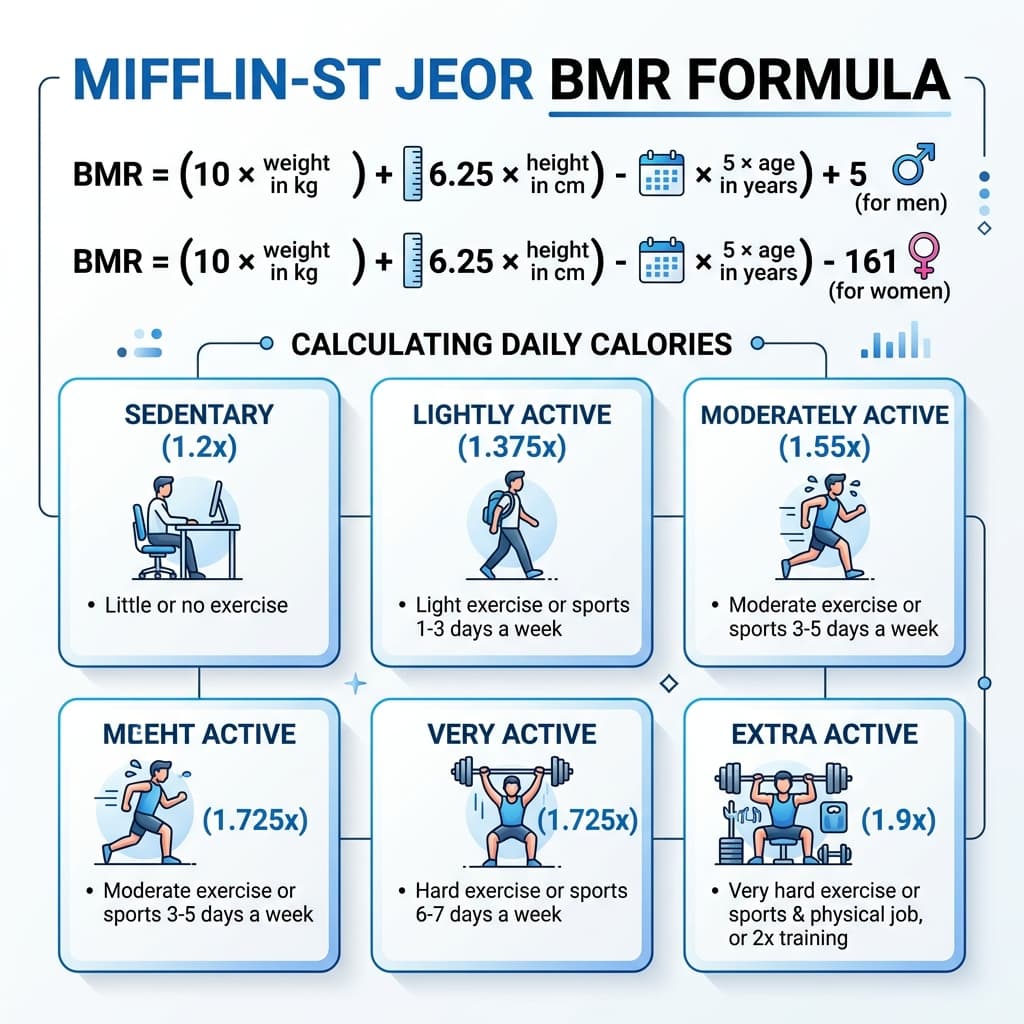
Mifflin-St Jeor BMR formula:
- Men: (10 × weight in kg) + (6.25 × height in cm) − (5 × age) + 5
- Women: (10 × weight in kg) + (6.25 × height in cm) − (5 × age) − 161
Example: a 30-year-old woman, 165 cm, 65 kg has a BMR of roughly 1,437 calories. With moderate exercise (3–5 days/week), her TDEE is 1,437 × 1.55 = 2,227 calories. That is her maintenance level.
Want the calculation done instantly with metric or imperial inputs? Our calorie calculator handles both and shows the breakdown by formula.
Activity Multipliers
Choosing the right activity multiplier is where most people go wrong. People consistently overestimate their activity level — "lightly active" usually describes most desk workers with 3 gym sessions per week.
| Activity Level | Multiplier | Who It Fits |
|---|---|---|
| Sedentary | × 1.2 | Desk job, no exercise |
| Lightly Active | × 1.375 | Light exercise 1–3 days/week |
| Moderately Active | × 1.55 | Moderate exercise 3–5 days/week |
| Very Active | × 1.725 | Hard exercise 6–7 days/week |
| Extra Active | × 1.9 | Physical job + hard daily training |
Practical rule: if you have a desk job and hit the gym 4 times a week, you are "Lightly Active," not "Moderately Active." Honest self-assessment here prevents a 200–300 calorie overestimate that quietly stalls fat loss.
Macros Explained
Macronutrients are the three major categories of calories: protein, carbohydrates, and fat. Calories set the overall energy balance; macros determine what your body does with those calories — whether it builds muscle, stores fat, or runs efficiently.
- Protein (4 kcal/g): Builds and repairs muscle tissue. The most thermogenic macro — your body burns roughly 25–30% of protein calories just digesting it. Also the most satiating.
- Carbohydrates (4 kcal/g): Primary fuel for high-intensity exercise and brain function. Not inherently fattening — surplus calories cause fat gain, not carbs themselves.
- Fat (9 kcal/g): Essential for hormone production, fat-soluble vitamin absorption, and cell membrane integrity. The most calorie-dense macro — easy to over-consume without noticing.
Use our macro calculator to get exact gram targets for protein, carbs, and fat based on your TDEE and goal.
Macro Ratios by Goal
There is no universal macro split — the right ratio depends on your goal, training style, and how your body responds. Here are evidence-based starting points:
| Goal | Protein | Carbs | Fat | Calorie Adj. |
|---|---|---|---|---|
| Fat Loss | 35–40% | 30–35% | 25–30% | −300 to −500 from TDEE |
| Muscle Gain | 25–30% | 45–55% | 20–25% | +200 to +300 from TDEE |
| Body Recomp | 35–40% | 30–40% | 20–30% | Maintenance (±50) |
| Endurance | 20–25% | 55–65% | 15–20% | Maintenance to slight surplus |
| Maintenance | 25–30% | 40–50% | 25–30% | At TDEE |
These are percentage-of-calories splits. Converting to grams: divide the calorie allocation by 4 for protein and carbs, divide by 9 for fat. Our protein calculator will also give you the daily protein target in grams directly from body weight.
How to Set Your Macros Step by Step
Follow this sequence — in this order:
- Step 1 — Find your TDEE. Use the TDEE calculator with an honest activity level.
- Step 2 — Set your calorie target. Cut 300–500 for fat loss, add 200–300 for muscle gain, stay at TDEE for maintenance.
- Step 3 — Set protein first. Target 0.7–1g per pound of bodyweight (1.6–2.2g/kg). This is non-negotiable — low protein in a deficit causes muscle loss.
- Step 4 — Set fat floor. Minimum 0.35g per pound of bodyweight (0.8g/kg) to support hormones. More is fine; less risks hormonal disruption.
- Step 5 — Fill remaining calories with carbs. Carbs are the flex macro — adjust them up or down based on remaining budget after protein and fat are set.
Example for a 180 lb man targeting fat loss at 2,400 TDEE: calorie target = 2,100 kcal → protein = 180g (720 kcal) → fat = 70g (630 kcal) → carbs = (2,100 − 720 − 630) ÷ 4 = 188g carbs.
Common Mistakes That Kill Results
Overestimating activity level
Choosing "very active" when you have a desk job and train 3x/week inflates your TDEE by 200–400 calories. Start conservative and adjust after 2 weeks of data.
Using gross exercise calories in TDEE
TDEE already includes exercise via the activity multiplier. Adding your Fitbit's burn on top causes double-counting and creates a false surplus.
Ignoring protein on a cut
A calorie deficit without adequate protein causes the body to burn muscle for fuel. This lowers your BMR permanently, making future fat loss harder. High protein protects lean mass.
Setting macros before calories
Macros must be calculated from your calorie target, not set in isolation. Picking "40% protein" without a calorie number means nothing.
Not recalculating after weight change
TDEE drops as you lose weight — your lighter body burns fewer calories. Recalculate every 10 lbs lost or after any significant change in training volume.
TDEE & Macro FAQs
How accurate is TDEE from a formula?
Should I eat less on rest days?
Does TDEE change after prolonged dieting?
What protein source is best for hitting macro targets?
Can I use TDEE for keto or low-carb diets?
Author Spotlight
The ToolsACE Team
ToolsACE is an independent platform founded in 2023 by a team of software developers and educators. We build free, privacy-first tools and write guides to help people make better decisions — without sign-ups, paywalls, or data tracking.