Body Recomposition: Lose Fat and Gain Muscle at the Same Time
The fitness industry says you must choose: bulk or cut. The science says otherwise — for the right people, under the right conditions, losing fat and gaining muscle simultaneously is real. Here is exactly how it works.

What Is Body Recomposition?
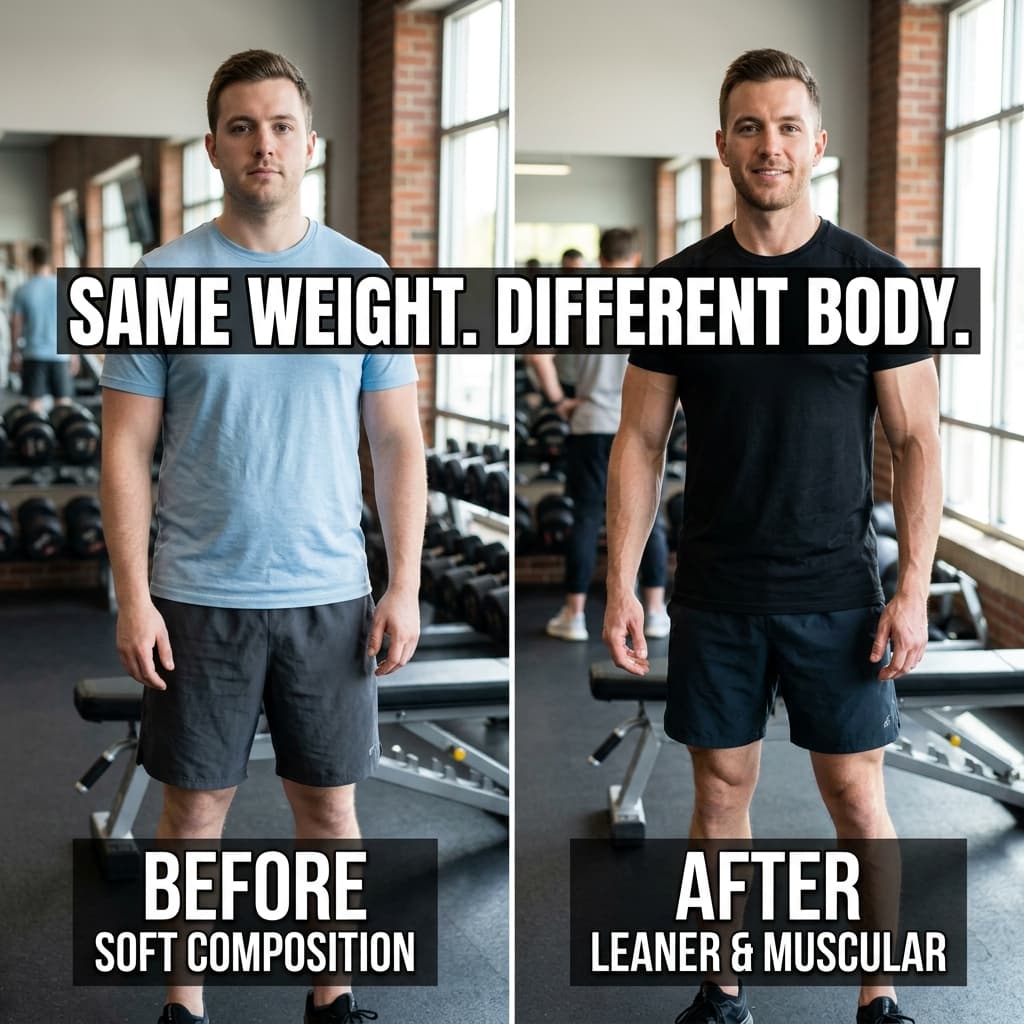
Body recomposition — "recomp" — is the process of simultaneously reducing body fat percentage while increasing lean muscle mass. Instead of the traditional bulk-then-cut cycle, recomp attempts to do both at once by eating at or very near maintenance calories while training hard and prioritising protein.
For decades, conventional wisdom held that this was physiologically impossible: gaining muscle requires a caloric surplus (anabolism) while losing fat requires a deficit (catabolism). These two states appear contradictory. The key insight: the body does not operate in hour-long discrete states — it can be in a catabolic state in some tissues while anabolic in others, particularly when protein availability and training stimulus are high.
Before starting a recomp, know your baseline. Use our body fat calculator and lean body mass calculator to establish what you are working with — fat mass vs. lean mass — so you can track real changes over months.
"Recomp is slower than a dedicated bulk or cut — but it produces a body that looks better year-round and avoids the mental and physical cost of extreme phases."
Who Can Recomp?
Recomposition is not equally accessible to everyone. The conditions that make it most achievable:
Beginners (0–12 months training)
Untrained muscles respond to resistance training with rapid protein synthesis even in a deficit. "Newbie gains" are essentially recomp. High potential.
Returning after a break (detraining)
Muscle memory allows faster reacquisition of lost muscle. Former athletes returning to training after months off experience near-beginner responsiveness.
Overweight individuals (>25% BF men, >33% BF women)
High body fat stores supply energy for muscle building even in a caloric deficit. The larger the fat reserve, the easier recomp becomes.
Intermediate trainees
Possible but slower. Progress is measured in months, not weeks. Patience and accurate tracking are essential.
Advanced / competitive athletes
Very difficult. Near-optimal already — marginal gains in both directions are slow and may require dedicated phases.
Calorie Setup for Recomp
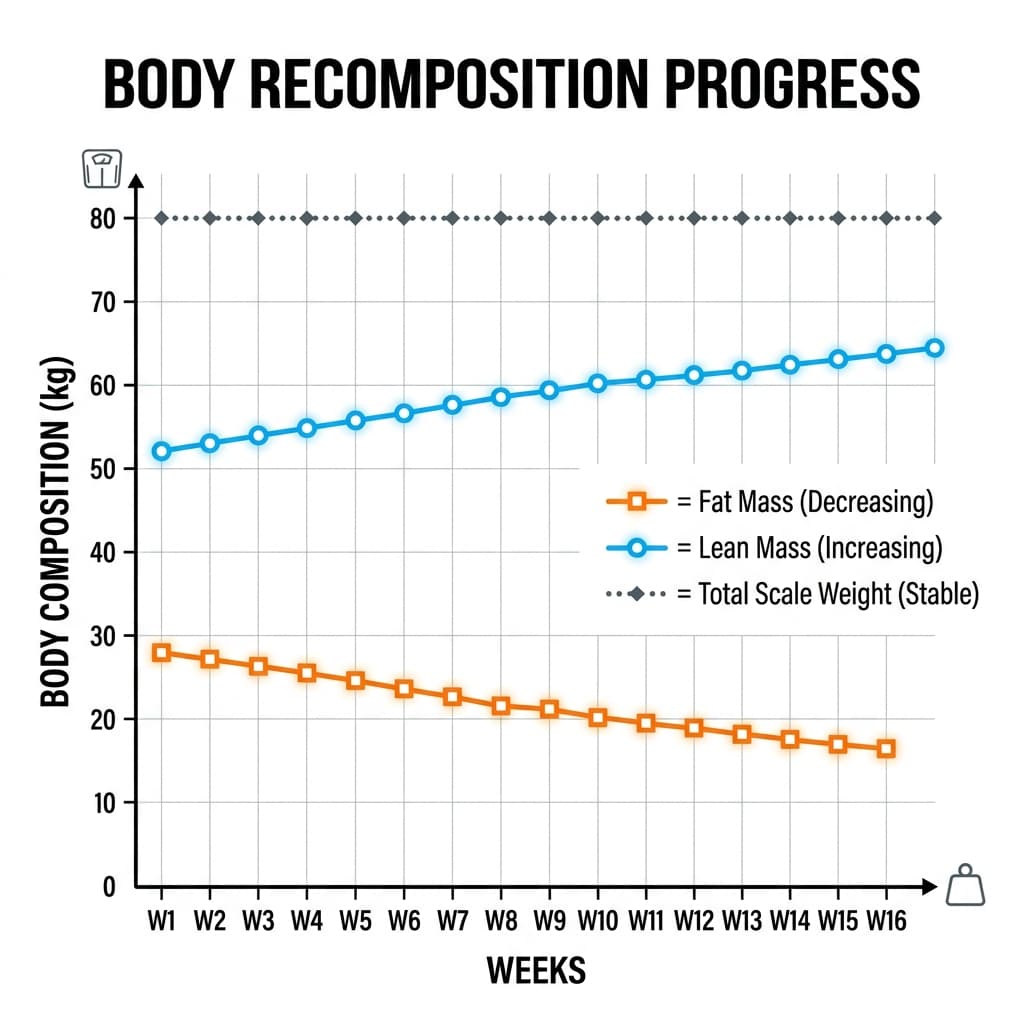
Recomp requires eating at or near maintenance — typically within ±100–200 calories of your TDEE. This is the hardest part for most people because it feels like nothing is happening. There is no dramatic deficit, no surplus, no dramatic week-to-week scale movement.
The recommended range depends on your starting body fat:
- Higher body fat (>25% men / >33% women): 100–200 kcal below TDEE. Fat stores supply the remaining energy for muscle synthesis.
- Moderate body fat (15–25% men / 25–33% women): Maintenance ± 50 kcal. Essentially neutral energy balance.
- Lower body fat (<15% men / <25% women): 50–150 kcal above TDEE. A small surplus favours muscle retention without significant fat gain.
Find your exact maintenance calories with our TDEE calculator, then apply the appropriate adjustment above. Our macro calculator will give you protein, carb, and fat gram targets from that calorie number.
Why Protein Drives Recomp
Of all the variables in a recomp protocol, protein intake has the largest independent impact on outcome. Protein does three things simultaneously that are uniquely valuable for recomposition:
- Provides muscle protein synthesis substrate — the amino acids needed to build new contractile tissue after resistance training
- Is anti-catabolic — high protein availability signals the body to spare muscle during energy restriction, even mild restriction
- High thermic effect — 25–30% of protein calories are burned in digestion, effectively reducing net calorie absorption and improving fat loss without reducing intake
The evidence-based target for recomp: 0.8–1.0g per pound of bodyweight (1.8–2.2g/kg). This is meaningfully higher than general health guidelines. Use our protein calculator to get your daily gram target.
| Body Weight | Minimum Protein | Optimal Protein (Recomp) |
|---|---|---|
| 130 lbs (59 kg) | 91g/day | 104–130g/day |
| 160 lbs (73 kg) | 112g/day | 128–160g/day |
| 190 lbs (86 kg) | 133g/day | 152–190g/day |
| 220 lbs (100 kg) | 154g/day | 176–220g/day |
Training for Recomp
Nutrition handles the substrate; training handles the stimulus. Without consistent resistance training, high protein intake and maintenance calories do not produce meaningful muscle gain — protein synthesis requires a mechanical stimulus to be activated at scale.
Recomp-optimal training characteristics:
- Progressive overload is mandatory. Lifting the same weights at the same rep ranges week after week is maintenance training, not growth training. Add weight or reps consistently.
- 3–5 sessions per week. Frequency distributes protein synthesis stimulus more effectively than cramming volume into 1–2 sessions.
- Compound movements first. Squat, deadlift, bench press, row, overhead press — these drive the most muscle protein synthesis per unit of time and calories burned.
- 6–20 rep ranges. Both lower (strength) and higher (hypertrophy) rep ranges build muscle effectively. Variety across sessions is fine.
- Minimize excessive cardio. Cardio creates additional caloric burn that can push you into too large a deficit — undoing the maintenance-calorie setup. Use cardio for cardiovascular health, not as a primary fat-loss tool during recomp.
Measuring Progress (Not Just Weight)
The scale is the worst metric for recomp. If you are gaining muscle (denser tissue) while losing fat (less dense tissue), your weight can stay exactly the same — or even increase slightly — while your body composition improves dramatically. People quit recomp because the scale does not move, not because it is not working.
Better measurement approaches:
- Body fat percentage: Track monthly with calipers, DEXA, or BIA. A drop in body fat % with stable weight = successful recomp. Use our body fat calculator for Navy method estimates.
- Waist-to-height ratio: A shrinking waist with stable weight is one of the clearest recomp signals. Track with our waist-to-height ratio calculator.
- Strength numbers: If your lifts go up over 12 weeks, muscle is being built — regardless of what the scale says.
- Progress photos: Taken in the same lighting, same time of day, every 4 weeks. Visual changes over 12–16 weeks tell the real story.
- Measurements: Waist circumference decreasing + shoulder/arm/chest measurements increasing = textbook recomp.
Realistic Recomp Timeline
Recomp is slower than dedicated bulking or cutting. Set expectations accordingly:
| Timeframe | Expected Change | What You Will Notice |
|---|---|---|
| Weeks 1–4 | Minimal scale change | Strength improving; body feeling tighter |
| Weeks 5–12 | −0.5–1% BF; +1–3 lbs lean mass | Visible muscle definition emerging; clothes fitting differently |
| Months 4–6 | −1–3% BF total; +3–6 lbs lean mass | Clear physique change visible in photos; significant strength gains |
| Month 6+ | Diminishing returns | May benefit from dedicated bulk or cut phase at this point |
Track your lean body mass monthly using our lean body mass calculator to verify the numbers are moving in the right direction.
Body Recomp FAQs
Is body recomposition possible for everyone?
How long should I run a recomp?
Why is the scale not moving during recomp?
Can I do cardio during recomp?
Do I need supplements for recomp?
Author Spotlight
The ToolsACE Team
ToolsACE is an independent platform founded in 2023 by a team of software developers and educators. We build free, privacy-first tools and write guides to help people make better decisions — without sign-ups, paywalls, or data tracking.