Lean Body Mass Calculator: The Number That Actually Tracks Your Progress
Bodyweight lies. Two people can weigh the same and look completely different. LBM is the number that exposes the truth — and drives every protein, calorie, and training decision worth making.

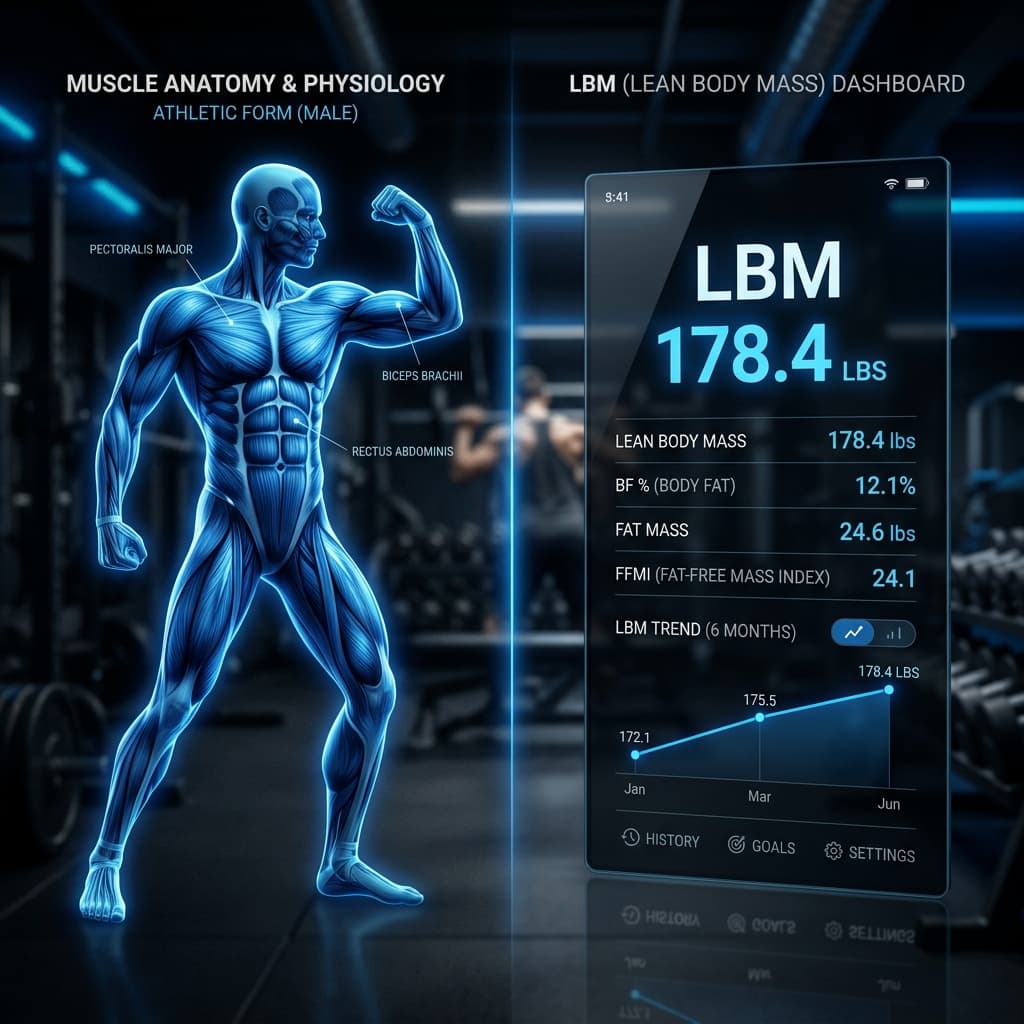
What Lean Body Mass Actually Measures
Lean Body Mass (LBM) is everything in your body that is not fat — muscle, bone, organs, water, connective tissue. A 180-lb person at 25% body fat carries 135 lbs of LBM. The same 180-lb person at 15% carries 153 lbs of LBM. Same scale weight. 18 lbs more lean mass. Completely different body — and different metabolism.
Use our lean body mass calculator to get your number. That gap is what training and nutrition actually move. The scale never shows it.
“Scale weight is noise. LBM is signal. The day you stop weighing yourself and start measuring lean mass is the day your training stops feeling random.”
Three LBM Formulas — Which to Use
Three validated formulas exist. Our LBM calculator runs all three and returns the average — more reliable than any single estimate.
| Formula | Error | Best For |
|---|---|---|
| Boer | ±3% | Adults 18–65 — gold standard, DEXA-validated |
| James | ±4% | Lighter individuals, older formula |
| Hume | ±4% | Conservative estimate, underestimates muscular |

Boer is the modern standard. James overestimates for heavier subjects. Hume underestimates lean, muscular individuals. Use the median of all three for best accuracy — that is exactly what our calculator does.
Setting Protein Targets From LBM
Protein targets should be calculated from LBM, not total bodyweight. Fat tissue requires no protein for maintenance — using total weight inflates the target for anyone above 20% body fat.
| Goal | Protein per kg LBM | Example (70kg LBM) |
|---|---|---|
| Sedentary | 1.0g | 70g/day |
| Active (3+ days/week) | 1.6–2.0g | 112–140g/day |
| Cutting (preserve muscle) | 2.4–2.8g | 168–196g/day |
| Strength athletes | 2.0–2.4g | 140–168g/day |
LBM-Based Protein
Target protein grams from lean mass only — fat tissue has no protein requirement. This keeps targets accurate and avoids unnecessary intake.
Precision Goals
Pair LBM with TDEE and your protein calculator for a complete, personalized macro plan calibrated to your actual composition.
Tracking Recomposition With LBM
Recomposition — losing fat while gaining muscle — is invisible on the scale. The only way to see it is by tracking LBM every 4–6 weeks under the same conditions: morning, post-bathroom, pre-food.
Why Scale Weight Lies:
Scale Weight
Useless for body recomposition
LBM Tracking
Reveals Truth of actual progress
Measure Consistently
Same time of day, same hydration state, same method. Day-to-day variation is water. Track weekly averages, not daily numbers.
Interpret Rate of Change
Trained lifters add 0.5–1 lb of LBM per month maximum. Early gains include muscle plus glycogen storage — not pure contractile tissue.
Recalculate Every 6 Weeks
LBM shifts as you lose fat or gain muscle. Recalculate every 4–6 weeks, or whenever scale weight changes by more than 5 lbs.
Three Mistakes That Distort Your LBM
Using Total Weight for Protein
A 200-lb person at 30% body fat has 140 lbs of LBM. Protein for 200 lbs totals 180g. Protein for 140 lbs LBM totals 126g. That 54g gap adds up daily and the extra protein does nothing for muscle.
Not Recalculating After Change
LBM shifts as you lose fat or gain muscle. Recalculate every 4–6 weeks, or whenever scale weight changes by more than 5 lbs.
Confusing LBM Drop With Muscle Loss
Short-term LBM drops during cuts are usually water and glycogen depletion — not muscle. True muscle loss is gradual and correlates with strength decline across multiple weeks.
Frequently Asked Questions
Is LBM the same as muscle mass?
Can LBM go down?
Which LBM formula is most accurate?
Should I use LBM for medication dosing?
How often should I recalculate LBM?
Author Spotlight
The ToolsACE Team
ToolsACE is an independent platform founded in 2023 by a team of software developers and educators. Our editorial team writes, researches, and reviews every article and tool guide on this site. We built ToolsACE because we were frustrated by tools that required sign-ups, tracked your data, or hid answers behind paywalls. Everything we publish is written by people who use these tools themselves — students, engineers, and professionals who understand the problems they’re solving.