The Lab Without Limits: How Chemistry Calculators Transform Science Education in 2026
From molar mass to equilibrium constants, chemistry students spend hours on calculations that should take seconds. Discover how precision chemistry calculators free you to focus on understanding, not arithmetic.


The Calculation Bottleneck
Chemistry is fundamentally about understanding how matter behaves. But somewhere between learning the theory and applying it, most students get stuck in the arithmetic — converting grams to moles, balancing equations, computing equilibrium constants — mechanical steps that consume study time without building conceptual depth.
In 2026, chemistry education is shifting. The best students aren't the ones who can compute a molar mass by hand fastest — they're the ones who understand why it matters, what it tells you about a reaction, and how it connects to real-world applications. Calculators handle the arithmetic. Understanding is your job.
ToolsACE has built a complete library of chemistry calculators covering stoichiometry, equilibrium, electrochemistry, acid-base chemistry, and molecular structure. This guide maps each tool to the course topics where it applies, so you know exactly which calculator to reach for during problem sets, lab prep, and exam review.
"The goal of a chemistry calculator isn't to replace thinking — it's to eliminate the arithmetic so you can do more of it."
Stoichiometry: The Core of Quantitative Chemistry
Stoichiometry problems — converting between mass, moles, and molecules — appear in every chemistry course from high school through graduate level. They're also the source of most arithmetic errors, because they chain together multiple unit conversions and the mistake in step one cascades through every subsequent step.
Start with our molar mass calculator, which takes any chemical formula and returns the precise molecular weight in g/mol. For gas-phase calculations, the molar mass of gas calculator applies the ideal gas law to relate mass, pressure, volume, and temperature in a single interface.
- Reaction yield: Our theoretical yield calculator determines the maximum possible product from your limiting reagent, factoring in stoichiometric ratios from the balanced equation.
- Combustion analysis: The combustion analysis calculator determines empirical formulas from combustion product masses — a core analytical technique in organic chemistry.
- Avogadro's number: Use the Avogadro's number calculator to convert between moles and particle counts instantly.
- Mole fractions: The mole fraction calculator handles solution composition for colligative property problems and gas mixture calculations.
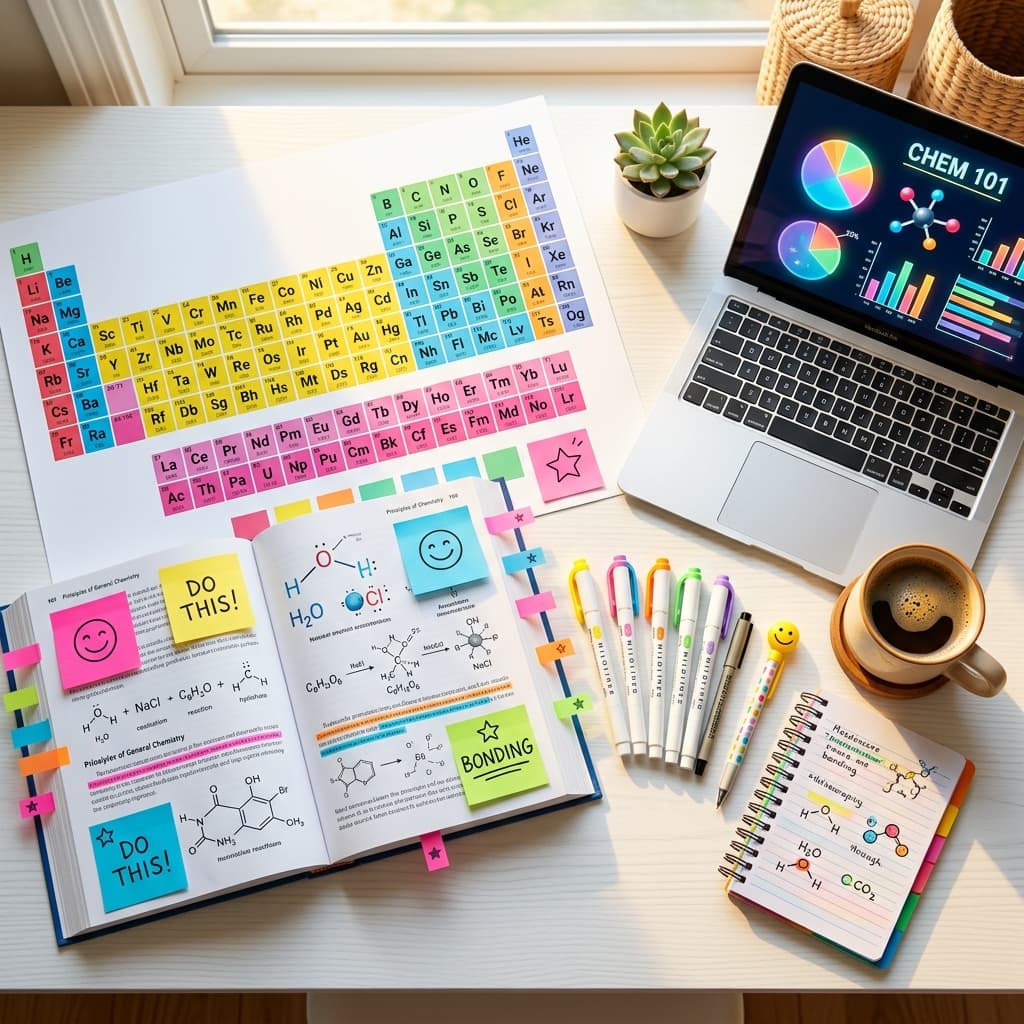
Equilibrium & Kinetics: Dynamic Chemistry
Chemical equilibrium is one of the most conceptually dense topics in chemistry — and also one of the most calculation-heavy. Equilibrium constant expressions, reaction quotients, ICE tables, Le Chatelier's principle applications: each involves careful algebraic manipulation that's easy to get wrong under exam pressure.
Kc & Kp
Our equilibrium constant calculator computes Kc from equilibrium concentrations, while the Kp calculator handles gas-phase partial pressures.
Reaction Kinetics
The Q10 temperature coefficient calculator quantifies how reaction rates change with temperature — essential for biochemistry and industrial chemistry.
For enzyme kinetics specifically — a topic bridging chemistry and biology — our enzyme activity calculator and Michaelis-Menten calculator handle Vmax and Km computations from substrate concentration data. For radioactive decay and nuclear chemistry, the radioactive decay calculator and radiocarbon dating calculator provide precise half-life calculations.
Acid-Base Chemistry: pH, pKa & Buffers
Acid-base chemistry is where most general chemistry students encounter their first major calculation wall. The logarithmic nature of the pH scale, the relationship between Ka and pKa, Henderson-Hasselbalch buffer calculations — each concept requires careful numerical work to move from theory to a concrete answer.
- Hydrogen ion concentration: Our hydrogen ion concentration calculator converts between pH and [H⁺] in both directions, eliminating logarithm arithmetic errors.
- pKa: The pKa calculator converts between Ka and pKa, and calculates the degree of dissociation at a given pH.
- Neutralization: Use the neutralization calculator for titration stoichiometry — finding the volume or concentration of acid or base needed to reach equivalence point.
- Buffer systems: Our buffer pH calculator applies the Henderson-Hasselbalch equation, while the buffer capacity calculator determines how effectively a buffer resists pH change.
Time Cost of Manual Calculation:
pH from Ka by hand
8–12 Min Per Problem
ToolsACE Calculator
10 Sec Verified Result
Atomic & Molecular Structure
Physical chemistry and inorganic chemistry courses introduce a new layer of calculation complexity: quantum numbers, electron configurations, crystal structures, and electronegativity effects. These topics combine abstract theory with precise numerical rules.
- Electron configuration: The electron configuration calculator generates full and abbreviated electron configurations for any element, including exceptions like Cr and Cu.
- Electronegativity: Our electronegativity calculator pulls Pauling-scale values and calculates bond polarity between two elements.
- Effective nuclear charge: The effective nuclear charge calculator applies Slater's rules to estimate Zeff — essential for understanding periodic trends.
- Molecular weight: Our molecular weight calculator handles complex organic molecules and polymers, complementing the standard molar mass tool for larger structures.
- Crystal structure: For solid-state chemistry, the lattice constant calculator and Miller indices calculator cover X-ray diffraction and crystallography fundamentals.
- Double bond equivalents: The double bond equivalent calculator determines degrees of unsaturation from molecular formula — a key step in organic structure determination.
Your Chemistry Study Workflow
Work the Concept First
Before using any calculator, write out the formula and identify what you're solving for. The calculator confirms your setup — it doesn't replace understanding the problem.
Use Calculators to Check, Not Replace
Solve the problem manually, then verify with the ToolsACE calculator. Discrepancies reveal exactly where your reasoning diverges from correct method.
Build a Problem-Set Routine
For each chapter, identify which 2–3 ToolsACE tools cover that chapter's calculations. Bookmark them before starting the problem set — context-switching between calculator searches destroys flow.
Chemistry Calculator FAQs
Can I use these calculators during exams?
Are the chemistry calculators accurate enough for university-level work?
Which calculator should I use for a pKa problem involving buffer solutions?
Author Spotlight
The ToolsACE Team
ToolsACE is an independent platform founded in 2023 by a team of software developers and educators. Our editorial team writes, researches, and reviews every article and tool guide on this site. We built ToolsACE because we were frustrated by tools that required sign-ups, tracked your data, or hid answers behind paywalls. Everything we publish is written by people who use these tools themselves — students, engineers, and professionals who understand the problems they're solving.